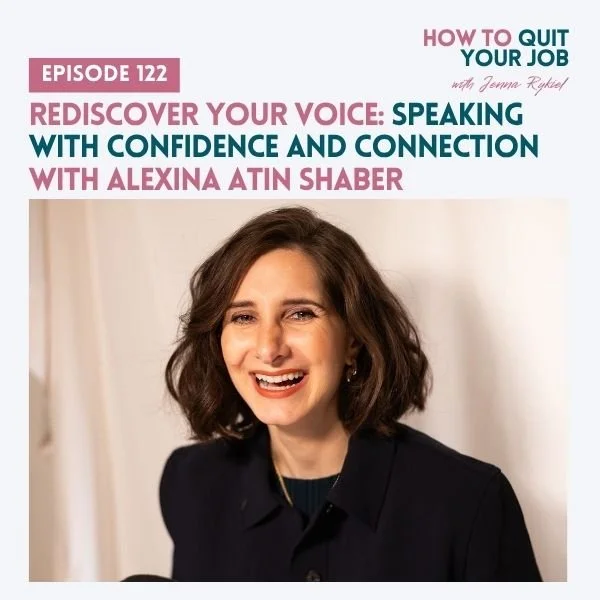
You can have a great business strategy, an amazing offer, and a clear idea of who you want to help, but at some point, you have to be willing to talk about what you do and why it matters. For many of us, especially through the transition into motherhood and entrepreneurship, using our voice with confidence can feel much harder than it sounds.
In this episode, I’m joined by my friend Alexina Atin Shaber, a communication coach who helps women rediscover and strengthen their voices. We talk about what it means to sound like yourself, how your voice can create connection, and why speaking from the heart can be so much more powerful than trying to sound polished or perfect. Alexina shares practical ways to become more comfortable with your voice, including an exercise for finding your natural speaking tone.
If you’ve been holding back from sharing what you really think, care about, or have to offer, I hope this conversation gives you a little more confidence to use your voice.
Ready for clarity and a simple action plan to get your business started? Schedule a free 1-hour consultation with me here!
What You’ll Learn from this Episode:
Why using your voice is such an important part of building a business.
How to sound like yourself instead of trying to sound polished or perfect.
Why speaking from the heart can create deeper connection with your audience.
How motherhood can change your sense of identity and influence the way you use your voice.
A simple exercise for finding your natural speaking tone and feeling more grounded when you speak.
How self talk, tone, and energy can influence the way you communicate and connect with others.
Listen to the Full Episode:
Featured on the Show:
Click here for step-by-step instructions to leave a rating and review to let me know what you think, and don’t forget to share the podcast with others who you think would benefit!
If you're looking for the right environment to start your networking journey, look no further than my group, the Mom Entrepreneur’s Circle. Sign up here for mutual support, advice sharing, and the tools you need for both you and your business to thrive.
Alexina Atin Shaber: Website | LinkedIn | Book a Discovery Call with Alexina
Episodes Related to Rediscovering Your Voice:
114. Trusting Your Intuition & the Spirit of Your Business with Olivia Bowen
115. Friendships That Fuel Growth: How Moms Can Expand Their Circle
Full Episode Transcript:
And I think this can be especially challenging when you're coming from a traditional career, where for years there were expectations, rules, and a pretty clear path for how to succeed. Entrepreneurship is different. It asks you to step out, to trust yourself, to share your ideas, and let people hear from you. And that's why I'm so excited for you to hear my conversation today with my friend Alexina, who is a voice and influence coach. She's a facilitator, she's a speaker. She helps women rediscover and strengthen their voice.
Today we talk about what it means to actually sound like yourself, why using your voice is really about creating connection, and what can happen in your business and your life when you stop silencing yourself and start speaking up. Let's get into it.
Welcome to How to Quit Your Job, the podcast for moms ready to ditch the nine-to-five and build a life and business they love. I’m your host, Jenna Rykiel. Let’s go.
Hello, my good friend Alexina, how are you?
Alexina Atin Shaber: I'm great, Jenna. I'm happy to be here.
Jenna: Yes. So this episode and our conversation is coming at the best time because today we're going to be talking about our voice and the importance of speaking, the importance of strengthening our voice, how to do that. And it's been a reoccurring theme with clients recently where clients come to me and they want to grow their business, they want to build their business, and they think it is a mystery of strategy. They think there's something that I need to do to unlock more revenue, unlock more clients, unlock more members.
And what's been so clear recently with some clients is that it's not so much the strategy, it's really how we're showing up. And one of those elements is how we are using our voice. I had a client who wanted to grow her membership. She does a mom's workout group, and I realized that when she had the opportunity to really talk about the membership, to talk about the community, to talk about all the things that were good in her business, she didn't because she didn't want to be pushy or salesy. And as soon as she shifted in really deciding to talk about and use her voice and talk about the benefits and be excited about what she was doing, not caring about being pushy or salesy, it attracted people. It had people taking action, it had people signing up.
And so that's why I think this conversation is absolutely perfect timing because you specialize in helping people find their voice.
Alexina: Oh, already starting so good. No, Jenna, I'm really grateful to be here. Thank you for bringing me on. And yes, I am a communications coach and I do help a lot of women and a lot of people rediscover their voice. There's a really specific reason why I try not to say “find your voice.” I know that's the rhetoric that we hear all the time. People need to find their voice. But the truth is, we've always had our voice. Maybe it's been silent for a few years, maybe it's been silenced. Maybe it's on mute, maybe something has happened where our voice and our perspective has shifted.
Take motherhood or parenting into consideration. The voice you had prior to the voice you are being called to have after is not just one of advocacy for you, but one for advocacy of your family, of your children because they don't have the voice yet. And so I like to talk about rediscovering your voice because you haven't lost it. It's not like you misplaced it and you have to find it again. It's been there. It's changing, it's shifting, but it's always been there. And so it's really this idea of creating a connection is what we're actually talking about. I love the example you just gave because what you helped your client do was you invited them to create a connection with the people that were coming in.
Already they had thought so much about the membership itself and the class itself and making people enjoy the time that they're there. But without speaking and creating this warm invitation, this is why this has been such an incredible benefit to our lives. You would be such a grateful addition to this community. Without closing that loop, you're leaving that connection open. And that's all speaking is. That's all public speaking is, is creating a connection either with yourself when you're rediscovering your voice or with others, your audience, the people that you want to be connecting with, even if it's one on one.
You're using your voice, your energy, your coherence between your energy and your language to create a connection. And that's what I work with my clients all the time is how do we make sure that you know what it feels like to be in that space of connection, to be in that space of flow, to be in that space of whatever you want to call it, that zone of genius, that center of creativity, whatever that feels like for you, I want you to feel the difference of when you're in it and when you're not in it because that unlocks a whole world of how you're able to communicate and show up differently.
Jenna: Yeah, 100%. If we are in the scenarios enough or if we are practicing enough, we can really tell the moments that we are feeling a little sticky or awkward when we are talking to someone, and then we know when we are in a flow. It just feels good. The words come out. And it's been so interesting with this client as well because we've talked about the feeling that she gets when she is speaking truth to her program and truth to her community. It's not made up. It's not saying something cute or fancy to sell somebody or convince somebody. It's like speaking from the heart, which feels amazing.
Alexina: Totally. I think that's the thing is like, what I work on with a lot of my clients and folks and even teams that I work with, there's so much public speaking technique you can learn. And believe me, it does help. It helps to learn how to use your hands. It helps to learn when you want to create some emphasis or a pause. Absolutely. Those are all things you could practice and get really good at. But you don't want to talk in real life like you would on a TED stage. You need to learn how to talk like yourself. And you need to know what excites you, what makes you passionate.
When you're talking about like speaking from the heart or speaking from that fuel, that passion place, that fire, there's a reason you care about it. When you're able to talk about something you care about, people feel that. There's emotion there. We are emotional beings. We are not always rational beings. And so when somebody can feel you, you know, when they say like, do you feel me? That is why we say that because it's a feeling. It's a feeling where you're like, whoa, what are they going to say? Whoa, how do they know that about me? You're speaking to somebody's emotions rather than just straight facts.
And there's a time and place for that, too. Again, that's what's so cool about our voice. That's so cool about this instrument that we have is that you don't wake up and you're like this violinist protege. You don't just pick up a violin and know how to play violin. You have to practice, you have to try different things, you have to learn chords, you have to practice that. But once the notes are gone and you're just playing, that's how you know how well you know your instrument. And we all have that ear, we all have that ability to tap into that. It's just thinking about it sometimes in different ways helps people realize the power that they have with the words that they can use or the tone or the energy they're putting to it.
I like to think about it as starting with yourself, especially if you're not super keen on public speaking, which I find very intimidating for a lot of people. The first things you can do are listen to how you speak to yourself. What tone are you using? What words are you using? Because especially as parents, how we talk to ourself is actually how our kids are going to learn to talk to themselves. They're so perceptive and attuned to our energy because that's what they understood pre verbal. All there was energy before we had the words. So that's instinctual. That's something that like, we've had it for generations and generations. And so that's a great place to start in terms of where you can think about the words you're using, the tone you're using, and is there coherence between that?
Jenna: I love that. And actually an episode just recently, 117, I talked about how to increase your capacity with better self-talk. So going back to that one and understanding like there is just so much power in self-talk. This also reminds me because I fall off the wagon a little bit on my self-talk for sure. It is something that you have to be diligent about and you have to really notice because it can go off the rails.
But I noticed, this just makes me think about a time in corporate when I'm interacting with a lot of people. There's a lot of Slack messages, there's a lot of text reading, and I noticed that for some people, I would always put certain tones and certain emphasis that had me feeling like the person was either like critiquing me or bossing me or just responding in a not loving way. And I noticed this and I remember I started reading all of my Slack messages with a very like excited, almost like a valley girl tone because I didn't want what I prescribed. And it helped my relationships so much. That doesn't necessarily apply to all of this, but it just came to mind because that's a bit of self-talk, right? It's like how we are reliving or experiencing the sentence that's in our head.
Alexina: Well, that's tone. You literally just shifted the tone. You can see the same sentence in three different ways easily. What time is the meeting? What time is the meeting? What time is the meeting? You can say it in so many different ways that either denotes a question or a fact. So I love that you recast everybody tonally, because it truly does, not just like trick your brain, but like level sets your brain into realizing my relationship to this either person or that's running things a little bit right now. It's not necessarily truth. And so when you just level the playing field, it made it a little bit more truthful, to be honest. So you can really recognize what's being said.
Jenna: Yeah, and not put my mental drama on it. So how do you or what do you think about in the grand scheme of rediscovering your voice? I work with a lot of moms that really, I think, would feel like and think that they lost their voice, right? Especially when we feel as if we've lost a part of our identity. Of course, we've gained an amazing part of our identity in motherhood. But there's also an entire transition of a bit of restructuring and a bit of loss. And for those moms who then also want to put value out in the world, they want to have, build something that gives them purpose, gives them meaning, and they just don't know how to talk about it. Or maybe even it's not that they don't know how to talk about it, but they just don't have the confidence or are too worried about what other people think or are second guessing themselves. What are your thoughts on supporting these moms?
Alexina: First of all, I'm in such awe and solidarity of these moms. So let's just start there. To choose to be a parent is not for the faint of heart, and it is the single most dramatic timeline shift in your life. And to not really give it the reverence that it deserves and not realize the toll that takes on you, because you knew you. I mean, presumably, you knew you before you had a kid. And then now there is a completely different dimension of yourself and your personality and this person that you've grown and the responsibility that you have and the everything changes.
The relationship with your partner or partners, with your family, with yourself, with your time, everything shifts. And so first, to just allow there to be a lot of reverence for what you've just gone through and experienced because I too had that same timeline shift, transition shift, especially when you see things that are very difficult happening, I think, in the world at the same time and you really understand parenthood in a very new way. So number one, you got to not just like give yourself grace, but just really honor this time that's changing you.
And the second thing I'd say is to begin to rediscover your voice is to begin to rediscover yourself and your stories and your upbringing and your background and one of the best things about kids is if you really let them, they are our greatest teachers. They will teach you so much about yourself that you didn't even wish you wanted to know. Or you can embrace that journey as the student.
And you know, I always make this joke, my little boy, Alessi, he just turned three last month. And I always talk about how he is the single best teacher I have. But I talk about him as if he's this like flashlight and no matter how much I work I do, no matter how much I think I've really grown, he's so good at being like, oh, right there, you could work on that actually. And maybe when you get time, maybe a little more patience right here would be great. And also I noticed this thing up here that if you can take care of that too, you know, it's like, yep, got it. Mm hmm. Yeah.
So what's so funny is that these are all like really helpful mirrors to see where you need to grow. And so if you're really trying to rediscover who you are, it's realizing that you're changing and going back to those perspectives and recognizing what my kid's trying to teach me right now is related to something else, right? It's a lot of this is doing the work. And the way that transforms your voice is that you are able to either look at things with a new perspective or really be able to try to understand what your perspective even is and why you are the way that you are and what value you bring and why you're such a great parent in this regard or maybe there's like a reason your partner is a great parent in this regard and that's why it's super complimentary or there's just so much you discover.
And so the more you discover about you, you actually are able to then lend to your voice. Because if you find you can be really compassionate in a moment with your child when they're having a really hard time, that same voice can be compassionate towards yourself or to somebody else. That same voice, if somebody is, you know, trying to touch your kid and they're like, oh, you're so cute, you're like, you don't get to touch my kid. Period. If you learn how to be discerning about what you do and do not allow, no matter whose comfort you're prioritizing, that's a lesson in learning how to rediscover your voice. And it's really important that as parents, we do that while they're young, because they're paying attention, they're learning. They are learning from us in ways that are shaping them. And so, like you said, there's so much that we are able to learn from, believe me again, like I said, the flashlight is on. You know, there's all kinds of things I need to work on.
But I think just even if you start at that relationship of your family dynamic, it's going to really help you understand the dynamics of your voice now and then how you want to present. We are multidimensional people. Who we are in the dimension of our home is who we are in the dimension of our business, is who we are in the dimension of our humanity. And the more we try to take away the barriers between those, the more coherence we can have with ourselves and then the more our message will land with clarity because we're not speaking in a calm voice but holding a frustrated energy. If you can hold your compassionate tone with a compassionate energy, it's seamless. You see, I'm providing a couple examples just to help understand where they can start and just even in the nuances of their tone, it really helps.
Jenna: And what it sounds like too is that this journey of really strengthening your voice, rediscovering it, using your voice in really powerful ways, it almost sounds like it's similarly like the lifelong journey we're on of our own self-discovery and evolution, which is again, it's like the work of a lifetime, it never ends.
And the other thing that comes to mind with this is I always tell people that I'm working with, because sometimes in coaching, we don't talk about business. We are talking about relationships, we're talking about partners, we're talking about kids, we're talking about imposter syndrome, we're talking about self-doubt, we're talking about trauma from years past. And sometimes I have clients who get self-conscious about that and they say, oh my gosh, we haven't even talked about business yet, almost like we're wasting time.
And I tell them, we need to talk through and process some of these things because you can't build the business that you want or you can't build the business that's aligned with you if you're building from this place that feels so misaligned or feels broken or feels so much tension. It's like, we have to work through that sticky stuff and then it'll make the entire process so much easier. If we try and build on a foundation that's shaky, it'll just collapse.
And it's really hard in the moment to understand that. When you're talking about voice and when you're talking about almost like the self-love part of it, that's what comes to mind where it's like, we are client zero all the time in all these things. We have to do the work with ourselves in order for these things that we're creating, even kiddos that we're creating, to prosper, to thrive. It is so important. I always say kids are the best self-development in disguise. But I also say entrepreneurship is too. And you're making me also think that this discovery, rediscovery and attention to our voice is also one of the greatest personal development journeys.
Alexina: That was so beautiful, Jenna. That was a very incredible weaving together of everything we just talked about. I love that metaphor of foundation that you just talk about because we can compartmentalize our life in different rooms, but if the foundation isn't strong, if the structure isn't at the right angle, you know, the floor will be sideways and then you're like, why are things rolling down this floor, you know? And there is an element to of course, the more you practice something, the more facility with which you'll start to use your voice. The more you'll trust your voice, the more you'll be able to know that when you open your mouth, what you have to say is valuable.
Trust that you bring the value. But with people that I work with, one of the most important starting places is understanding your perspective, is understanding you and your story and the things you care about and the things you will fall on a sword for. Just understanding where you are right now, which we again, like you said, we constantly are evolving. But to try to understand yourself, and then it helps you try to understand others, your audience, the people that you're speaking with, recognizing how they might be different, how they might process differently.
But that is where that connection, again, going back to the original point of speaking is you're developing a connection. And connection is what strengthens our foundation. We need each other. We need each other to reflect ideas, to collaborate, to develop community. So by using your voice, you're giving yourself this chance to create more connection in your life. You're giving people a chance to take part in learning what you're doing. If you don't communicate what you're doing, then how's anybody going to know it? How's anybody going to be able to stay on track with it or introduce you to the right person that might be an incredible partner or an incredible employee?
We all do really need each other and the fastest way for us to find each other is through our language, is through communication. And I understand that people might feel self-conscious or they might feel shy or they might feel not ready yet. And that's okay. You just start with the people you know. You start with your friends, you start with your loved ones, your chosen family. If your actual family is not necessarily the people, if it's a little too spicy there, you know, you start with the people that already love and see you and hear you and want to hear what you have to say. You just practice and the more you're able to trust yourself, see yourself, value yourself, you even said, you know, love yourself, love what you bring to the table. That's going to start extrapolating out and causing these ripple effects in your conversations and people are going to take notice.
There's one thing that I wanted to share about just a lot of the time people think, especially online, we see a lot of yapping videos right now. You see a lot of people being engaging with their communication and their technique and that's cool. I think that's actually pretty awesome that we get to see people in this practice that they're doing. But there is one thing that I've always found and that I share with my clients. I learned this from somebody who was an opera singer once, that one of the most instant ways you can calm your nervous system down and speak from a place of authority, do you want to do it with me? There's an exercise.
All right, we're going to try to find our natural tone. We are conditioned, especially as women, to speak with a higher rate or a higher tone, a tone voice. Oh my gosh, hi. You know? It can go really high and that's good because actually that creates a lot of enthusiasm, it creates a lot of energy automatically. We're talking really fast. We're so excited. Oh my gosh, I haven't seen you in so long. What's been going on? That's really good.
But until you're ready to really play your instrument, you stay with certain chords to start. And so we're going to find our natural tone. And the way you find your natural tone is you take a deep breath and you go, and on the exhale, you're going to just sort of sigh out and you're going to go, ha. It's going to sound really low. Try it with me. Ready? Ha. Do you have that tone? Can you access that tone? You can speak from that tone. It's lower, right? It's closer to your, it's closer to your stomach, your diaphragm, your sacrum. I can't see this. I'm touching my stomach. But when you're able to talk from this lower tone, consciously, you naturally slow down your speaking.
Jenna: Yeah, there's almost like a calming force in it as well.
Alexina: Because it's grounding, it's lower to the ground. It's a tone that you might hear in a lot of yoga classes, you might hear in a lot of places where you want to develop some kind of authority, you want to take your time with your words. You're not rushing. You make every word count. And it's a more inclusive way of speaking because people process sound and words at different rates. So if you actually want to be really inclusive, you kind of have to slow it down. And so naturally when you talk from that place, people take you seriously, people tend to want to lean in because you sound like you have a bit of gravitas and that what you're saying is coming from a wise place. I'll let you try it out a little bit, talking in your natural tone. That's a bit lower.
Jenna: Yeah, it's a bit lower. I think it's also good to talk in this tone because isn't it harder to hear higher pitch for some people as well? Yeah. I'm glad to say that I think for the most part, I'm only a few maybe octaves off of my natural tone when I'm doing the podcast or speaking. But it's a really different experience to speak from here. It feels like it's a full body experience, not in a tense, stressed way, but in a open, airy way.
Alexina: And what's cool is that you're sort of focusing on staying in that tone, which makes it so you naturally can't think about, oh my God, what am I saying? What am I saying? Is it coming out clearly? What are they thinking? Oh my gosh, have they yawned? Am I being boring? It's like, you don't have that mental drama because you're just taking it one word at a time and you're giving yourself the space. Because I found that with a lot of my clients, it's not about if they can communicate or not. We've been doing this our whole lives. We know how to communicate.
It's about, do they feel worthy to take up the space? Do they feel like what they have to share is valuable? And can they begin to communicate with themselves in a way that allows them to express themselves? Because that ultimately is what they want. They want to express themselves in an authentic way. So this is a starting point, because once you feel good about that sort of tone space, you can start going up and down in tune. You can play around, you can really add this like hard stop. Let a pause sit, play with the pace. There's so many fun things you can do from a technique standpoint, but you just want to create a connection. That's all you got to worry about.
Jenna: And I think what you just said is the most important piece for my people, is knowing that what you say is worthy. Every single one of my clients, it comes back to really believing that they're not bothering people, believing that they are worthy of what they have to say. There's so much mental drama that comes in and every single person I've ever talked to has worth and has so much wisdom and value to share.
I was just telling my client today, if you had the cure for cancer, you would be shouting it from the rooftops. And if people weren't listening or if people were saying, no, seems like a scam, you would, you would find a new way to communicate with them. You'd find different avenues, different tones, maybe different inflections, you would want to get that cure for cancer out into the world. And granted, I told her, my business is not the cure for cancer, hers is not either, but it is just as important some of the things that we are doing for our people, right? Like bringing them mental health, wellness, physical wellness, like helping them live a conscious and deliberate life. So many of those things are so worthy of sharing and sharing in a very deliberate and passionate way that we should be shouting it from the rooftops. We should be unapologetic about talking about the things that we are doing.
Every single person I've ever worked with is doing something so meaningful and so powerful, even if it does feel like it's just marketing or copywriting or some of these things that you can just kind of say, oh, that's not a big deal. But it is. These problems we're solving for people, this impact we're having in the world, the way that we're changed through it, it's worthy of talking about. It's worthy of wanting to share our story. It's worthy of inspiring other people, all of it. And so when you say that of that being one of the pieces, I'm like, yes, yes, yes, yes. Every single person who's listening has something to say and they are so worthy of sharing that. Everybody should know. And full permission, please do it. If you need permission, here it is on this episode.
Alexina: You are given permission to talk about what you care about because if you care about it, there is big value there. And if you care about it, you're going to speak about it from a very authentic place. People need to stop worrying about the technique and start worrying about what they have to say because if you care about it, it really matters. So use your words, speak from the heart. You will notice the more you do it, the more you get to share what you love outward. And then people will come to you because of the things that you love. It's a beautiful symbiotic relationship if you allow it to happen.
Jenna: It is. I love it so much. There's just such a power, a ripple effect that happens, even when we're talking to somebody who's completely not our ideal client, unrelated to anything in our business. But when we speak with heart and when we speak with passion and energy about it, it's amazing the impact that it has. Before we wrap up, I really want to also touch on your journey as a mom entrepreneur and what gave you the courage to leave a really great job in corporate.
Alexina: Thank you for asking. And thank you for, by the way, Jenna also was my coach, especially in my transition between pregnancy to becoming a parent. And I'm somebody that has a million ideas and wants to do all of them. I am this multi interested, multi hyphenate, culturally, emotionally, entrepreneurially. You know, I'm really, I'm really like the epitome of a multi hyphenate. And Jenna was such an incredible support throughout that process and to the point of recognizing when was the right time to say goodbye to this corporate identity and corporate life.
And the truth is, with my journey, you know, I come from brand marketing, advertising, that's a bit of my pedigree, I guess. But I did that in various different environments. I did it at prolific creative agencies for the brands you know and love in very big capacity. I worked at purpose-driven startups as either the heads of marketing or the VP of partnerships or just really a leadership role in these startups, including my own. I co-founded a company with some folks all around like a storytelling platform. And then I also did it in high tech. I did it at Apple.
And so the funny part about this whole journey is that when I got my first job in advertising, I took my job offer to my Buddhism professor in college. I had already graduated, it was recession, and I took this job offer to him and I said, professor, I don't know if I'll be doing good with this career, with this job. What should I do? And he said, hold on. So and this was one of the best creative agencies on the planet that I just got a job offer from. He said, so hold on. Let me get this right. You're not interested in learning from some of the most strategic and creative minds in business? Am I getting that right? I was like, well, it's not that necessarily. He's like, okay, cool. Go learn. Go learn the language. Go learn how to speak to millions of people through a brand, through a campaign. And that's honestly essentially what people are. We're just our own version of a brand in a lot of ways.
Personal branding is like a really big part of this, is again, like I said, knowing who you are, what's your story? Who are you talking to? What's that truth about yourself and then how to market that? And so throughout my career, I knew I had this mission that I was learning. I was learning and I was learning in a lot of different capacities. But the coolest part is I got to work with so many different types of people, and that's where I studied, and I learned how we communicate with one another, how you lead different people, how you make sure people feel like they have a voice at the table, you create a space for them to have not just a seat at the table, but a voice at the table. You check in to make sure that every voice is heard on a team.
That is how you collaborate. That is how you create an environment where people feel valued. And so when I was ready to leave my corporate job, I was a contractor at the time, actually, it was because I felt like I was ready to do something with everything I had learned. And it's still going to be a journey. I think that's the truth is that once you choose to do something unknown, it's going to remain unknown. And you just have to be okay with that being, you take it as easily as possible. You take it one step at a time, and then you recreate your life in a way that is aligned. And Jenna, you were a huge part of me just even being able to identify what that means for myself. So, but we need each other. Like I said, you don't do it by yourself. You do it with trusted people and it's through our communication, it's through our ability to develop that connection that it makes an impact.
Jenna: Yeah, it's so interesting too when you talk about marketing because marketing is just connection. It is just speaking to your people and helping to inspire them to action in so many ways. And you're right. I was telling someone just today that we need each other because when we're in it, we can't see or think clearly a lot of the times. We don't see our value, we don't see our strengths, we don't see the worthiness in us. And so many of us are blinded to it that it's important to have somebody in your life. It doesn't necessarily need to be a coach, but those people in our lives who tell us the best things about ourselves, it's like we just have to start believing them and we have to start seeing something bigger for ourselves. I love that you said, like, I had all of this accumulation of knowledge from all these years, learning from these different entities, and then I was just ready to build something of my own and bring value in a way that was so aligned.
Alexina: And I have to add, the other promise I made to myself was by the time my kid has memories of me working, it'll be because I'm doing something I truly love. And that was what gave me the timeline. So I do have to like, give credit to this little human that came through that makes me accountable in a lot of ways. And I love what you said about the different dimensions because something I do with my clients also is, if you have one mirror and that's the only mirror you've ever had, you just see yourself one dimension, one way. But then if you get the perspectives of other people, which honestly, perspective in Latin means to see clearly. So if you get these other mirrors from other people, you get to have this like look into infinity kind of like, you get to see the fractals of the mirror and of yourself and like of every angle.
Text three people that you trust how clearly they see you and ask them, what do you see in me that I might not see in myself? Or what do I do or what do I bring to a room that other people don't? Or just whatever question you want to hear that you can get these different perspectives because I find that with my clients when they read these responses, it helps expand their idea of themselves, which then already goes back into their ability to speak to that expanded sense of self.
Jenna: And this is a topic for an entire other podcast episode, I think. But what that makes me think of is the beauty of helping other people use their voice through questions. There's so much that probably people want to tell you that they're just not going to come out of the blue and tell you how awesome you are or how much you've impacted them or how much they look up to you. But if you just ask them that question, which I think is amazing homework, ask three people you trust those questions, what they think about you or how you've impacted them or whatever the question is, and allow them to use their voice and to share some pretty amazing things.
Alexina: It's a privilege. It's totally a privilege to receive and to provide that type of feedback. I've been on both sides. It's a total privilege.
Jenna: I love it. Alexina, thank you so much for treating us with your energy, your wisdom, everything you have to say. I know this has been a long time coming. We've been wanting to do this for a while and it just feels like this timing was so right.
Alexina: Thank you so much, Jenna. It's been such a pleasure, as always, but I'm just really happy to be able to have this conversation with you. Thank you.
Thanks for listening to this week’s episode of How to Quit Your Job: A Mom’s Guide to Creating a Life and Business You Love. If you want to learn more about how I can help you stop making excuses and start making moves, head on over to www.jenna.coach. I’ll see you next week.
Enjoy the Show?
Don’t miss an episode, follow the podcast on Spotify, Apple Podcasts, or RSS.