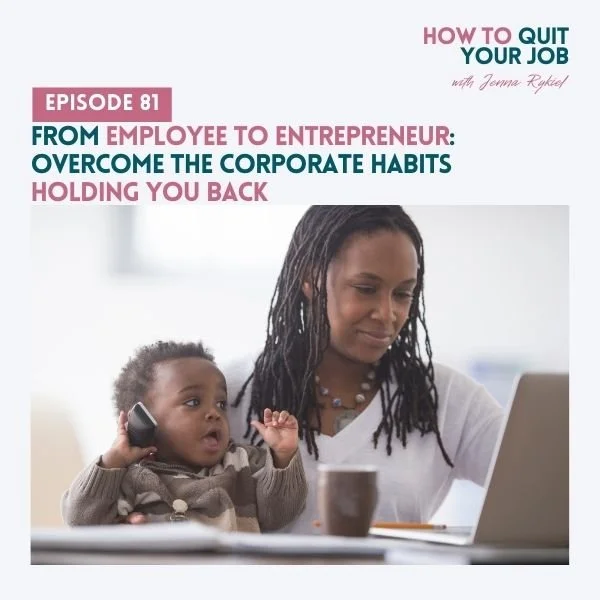
81. From Employee to Entrepreneur: Overcome the Corporate Habits Holding You Back
Starting a business after years in a traditional role can feel strangely uncomfortable, even when you're completely capable and deeply committed. The truth is, so much of what feels hard has nothing to do with your ability or desire; it's about the patterns and habits those corporate roles unintentionally shaped in you over time.
The shift from employee to entrepreneur requires more than just leaving your job or starting your business on the side. Your brain is wired for the world you came from, one that values predictability, thoroughness, and approval from leadership. But entrepreneurship needs something different. It asks for adaptability, self-trust, and a willingness to act before you have all the details figured out. When you step into this new world with old expectations, it creates tension and doubt that can keep you spinning in place.
In this episode, you'll discover how to consciously grow into the CEO version of yourself, even if you're still in your nine-to-five. Through specific questions and practices, you'll learn to interrupt those old habits of urgency, perfectionism, and overworking. Most importantly, you'll understand that thinking like a CEO is what creates the business, not the other way around. This shift takes time and compassion, but once you see these patterns, you really can't unsee them.
Ready for clarity and a simple action plan to get your business started? Schedule a free 1-hour consultation with me here!
What You’ll Learn from this Episode:
Why your brain defaults to certain patterns from corporate, and how these habits hold you back in entrepreneurship.
How approval seeking from your nine-to-five shows up in subtle ways when building your business.
What CEO check-ins are and specific questions to help you step into your future identity.
Why entrepreneurship rewards intention over hours spent at your desk.
How to start acting like the CEO of your life right now, even if you're still in a traditional role.
Listen to the Full Episode:
Featured on the Show:
Ready for clarity and a simple action plan to get your business started? Schedule a free 1-hour consultation with me here!
Click here for step-by-step instructions to leave a rating and review to let me know what you think, and don’t forget to share the podcast with others who you think would benefit!
If you're looking for the right environment to start your networking journey, look no further than my group, the Mom Entrepreneurs Circle. Sign up here for mutual support, advice sharing, and the tools you need for both you and your business to thrive.
Episodes Related to Employee to Entrepreneur:
Full Episode Transcript:
Welcome to How to Quit Your Job, the podcast for moms ready to ditch the nine-to-five and build a life and business they love. I’m your host, Jenna Rykiel. Let’s go.
Hi mom friends. I am genuinely excited to talk to you today because this episode covers a topic that is really important to know. And once you see it, you really can't unsee it. It's something that makes starting a business extra challenging for moms who have built their careers in traditional roles. And it's really important because it explains so much about why the beginning can feel confusing, heavy, and/or strangely uncomfortable. So we're going to get into that for sure.
But I also want to encourage you to follow the podcast. Like actually click the plus sign on whatever app you're listening on because new episodes come out each week. I've never missed an episode. Even through birthing a human, and each episode will absolutely move you towards starting and building a business and life you love. That's what it's all about.
So being notified that there is another piece of advice and wisdom and love each Wednesday morning is going to be so valuable on this journey. And I know that if you're someone who pops in and out, we need to start building some consistency. So use this weekly reminder as a tool and resource.
I want you to know that so much of what feels hard about starting a business after years in a traditional role or corporate environment truly has nothing to do with your ability or desire. It's about the patterns and habits that those roles unintentionally shaped in you over time. And don't get me wrong, a lot of great things came from those roles too. They likely gave you the expertise you have now, professionalism, communication skills, teamwork skills, right? And obviously an ability to juggle more responsibilities than we ever thought possible.
But because you're human, the environment you spent years in will shape how you think, how you work, and how you make decisions. That's natural and expected. Nothing has gone wrong. But when you step into entrepreneurship, the rules are very different. You go from employee to entrepreneur. The expectations change. And the way you need to think and operate, that changes too.
So you might find yourself navigating a completely different operating system and that transition can feel really disorienting, especially when you've never been told that this shift is part of the process. So today I want to walk you through what that transition actually looks like. I want to help you understand why your brain defaults to certain patterns and how to consciously grow into the CEO version of yourself with both compassion and clarity.
First, I want to talk about the difference between corporate thinking and entrepreneurial thinking. And when I'm saying corporate thinking, I don't just mean a typical corporation, okay? I'm really talking about a traditional nine-to-five where you are an employee and working for someone else's goals. Because even if you worked in a nonprofit or education or government, these same theories that I'm going to talk about apply.
First, one of the biggest shifts moms make when leaving a traditional role is moving from an environment that values predictability and order to one that values experimentation and self-trust. Corporate rewards thoroughness and preparation and consistency and alignment across different teams. Those skills matter tremendously in that context. They make you reliable, they make you an asset, they allow large systems to run smoothly.
Entrepreneurship though, it needs something different. It asks for adaptability and creativity, intuition, and a willingness to really act before you have every detail figured out. It rewards the courage to try small things or big things, to shift when needed, to pivot, and to see every step as part of the learning process.
It's so normal to come into entrepreneurship with certain expectations because your brain is wired for the world you just came from. You probably want clear direction. You want a foolproof plan. You want to know the right way to do things before you begin. Not because there's a lack of confidence, although many of my clients would argue that that is the case, but I want to assure you that it's because of your previous environment. That's what your previous environment required.
And when those things don't exist, it can create a lot of tension and doubt in your mind. Old habits die hard, and so a lot of the initial work in entrepreneurship is trying to step out of those old habits and mindsets, unlearn those things, so that you can make way for what entrepreneurship requires.
When you see this as a conditioning issue instead of a character flaw, my hope is that you step out of judgment and into strategy. This is not a you problem. This is just learning a new way to work, which takes time and practice. Both of which we'll talk about in this episode, actually how to do it.
Another pattern many moms carry with them from corporate, myself included, which I'll talk about, is the habit of overworking. Okay? When your value in a company is tied to responsiveness, long hours, being available for other people's timelines, your body learns to associate time spent with productivity.
This is exactly what happened to me when I first left corporate and started my own business. I recreated my work day almost exactly. So I was sitting in my office from eight to five, filling the day because that's what was familiar to me. I assumed that being in front of my computer meant I was taking my business seriously.
But instead of feeling productive, everything felt confusing and counterproductive. Okay? Without those meetings and deadlines and external direction, I found myself truly like spinning in place. My days felt full, but I saw very little progress in my business. And it eventually hit me that what made me successful in corporate was not going to be the key to entrepreneurial success.
It wasn't about the hours I put in. It was more about working smarter, not harder. It was about being intentional with my time. Not every activity is created equal in entrepreneurship. There are tasks that create a lot of value and are revenue generating, like talking to potential clients, making offers to help people, those sort of things. And then there are tasks that feel necessary but don't get us any closer to our goal.
And for me, this was things like working on a website, posting on social media, writing blog posts, right? When I started asking myself on a daily basis whether those actions were revenue generating or not, I started to see how much time I was wasting doing things that didn't push my business forward, but that felt good because I was working, right? I was filling the time. I was in front of my computer and working from eight to five.
And I realized that so much of the work that I did in corporate was not necessarily revenue generating activities, which is okay because large corporations and companies require a lot of that in order to function. But that's not the case for a new business. There are very clear activities that are more valuable than others, which means that it's not necessarily about the hours you work, it's about the value you create in those hours.
And once I let myself think differently, everything changed. It also made my work week far more fun because I started taking more time to do other things that filled my cup. I felt less guilty about time I spent with my kid. I was choosing fewer priorities and that mattered more than filling my calendar.
And when I let myself organize my work around the life I wanted instead of the life I had left behind, I began to get more done in far less time. And I created more results because what I was prioritizing and working on in my business was actually moving me towards my goal. It wasn't just busy work.
This is one of the first steps in thinking like a CEO, recognizing that entrepreneurship really rewards intention, not necessarily hours. A CEO is measured by their goal setting or visioning, the decision making, and the value they create for clients, not just the time that is spent in front of their desk. So that is the second pattern that I see all the time when we're shifting from employee to entrepreneur.
Another subtle pattern that many moms carry is approval seeking. Not in like a needy or insecure way, simply in a conditioned way. So corporate structures are built around layers of leadership, oversight, and alignment. Okay?
There's always someone to review your work, give feedback, sign off on things, or really just guide the direction of any initiative. And over time, you learn to wait for clarity and approval from above. You learn to double check, you learn to ensure everything is polished. You learn to make sure you are not stepping outside of expectations.
But when you step into entrepreneurship, that structure and approval hierarchy completely disappears. Suddenly you are the one approving your own ideas. You are the one directing your own work. And even if you feel excited about that freedom, it takes time for your brain to feel safe with it.
I see this all the time with clients. Just earlier today, I was coaching someone and she kept asking my opinion about the smallest decisions in her business. And I realized that she was used to a final decision being made outside of herself. And that she was wanting me to make a decision for her.
And listen, I'm more than happy to advise and give my fair share of opinions on what my clients should do. I don't hold back. Probably more than a traditional coach should, but I often notice that it's a conditioning around approval seeking and permission that some of my clients lean on from me.
And it's wanting me to review their work and give a final sign off because they are afraid that they'll make a mistake and what that means about them and their business. Entrepreneurship requires that you learn through experience and sometimes that means learning from our mistakes.
When it comes to making confident and quick decisions in business, our corporate conditioning is a huge obstacle. The hesitation you may experience is not a lack of ability, it's just lack of practice, right? Your brain is waiting for leadership that now needs to come from within. Learning to become the CEO of your business is largely about learning to trust the direction you set for yourself and all the little decisions along the way.
So we're conditioned to be an employee, but now we want to be the CEO. So how do we actually make that shift? Back in episode 37, I talked about how to achieve your goals and who you need to become. And the core idea from that episode applies here too. So to reach any new goal, the most important work is stepping into the identity of the person who can create it. And that's exactly what we're doing here.
I want you to start practicing being a CEO. Not just in the business you want to start or the business you've recently started, but the CEO of your entire life. You already are the CEO of your life right now, whether or not you have a business yet. You're also likely the CEO of your family. Your home, your schedule, and so much of the mental load you carry.
So the first step is grounding yourself in that identity and really getting to know who that version of you is. And at first, I will say it will be like shaking hands with a complete stranger. But through the practice that I'm going to talk about, you will get to know that person so much more clearly over time.
Before you grow into her fully, whatever that version of her looks like, it's helpful to understand where you're starting from. Okay? That means taking a moment to notice how your corporate experience is shaping your current habits. Not in a judgmental way, in a compassionate observational way. Okay?
You might notice that you wait for clarity or direction before acting. Maybe you recognize patterns around seeking approval or polishing something to perfection before sharing it. Maybe you feel this need to fill your calendar because full feels familiar and it feels productive. Or maybe you find yourself putting pressure on yourself to get things right.
These were all useful habits in a corporate environment. They kept you aligned, reliable, and effective. They simply don't map onto entrepreneurship. And this goes for you whether you have left corporate or whether you are still in corporate. If you're still in a traditional role where you have a nine-to-five and you're an employee working for someone else, notice these patterns in your day-to-day work day. Notice the different levels of approval. Notice the number of meetings and the amount of polishing and perfectionism that goes into any new initiative.
It's actually more beneficial if you are still in corporate because these patterns will be so much more obvious. So noticing where these patterns show up now in this moment will help you see what you might be carrying forward or what you might carry forward without meaning to once you are out of that corporate environment. And once you have that awareness, you can really start connecting with the identity you want to step into, the CEO identity.
Even if you're still in a traditional role, you can start acting like the CEO of your life and the CEO of your role right now. And this is where I want you to begin doing CEO check-ins with yourself. These can be tiny moments or longer journaling reflection exercises.
Sometimes it's as brief as just like pausing and reminding yourself of the behaviors and thoughts you want to embody as a CEO, things like taking action and learning from experience, or approaching your business and work like a science experiment and staying curious about what's working instead of really kind of taking every result personal, especially the negative results.
But other times it might look like a deeper journaling moment or exercise where you explore the details of your CEO identity. And I'm going to provide a ton of questions that will help you do that. And I want to encourage you also that you can always find the transcript where you can copy and paste these questions at jenna.coach/81. You can find the transcript to any episode by going to jenna.coach/episode number.
So I want you to do this exercise, tap into your CEO identity. You might reflect on the rhythms of that version of you, the rhythms of her day, right? What time she wakes up, how she supports herself energetically, how she makes decisions, how long she spends contemplating something before she chooses a direction, what kind of support and resources she intentionally builds around herself so that she can excel. All of these things.
This is where you begin stepping out of automatic doing, which the automatic doing or automatic avoiding, when you're doing anything automatically, you will do it from a place of your conditioning, right? Your default, the thing that your body and brain has learned over the past decade or longer.
It allows you to step out of that and into deliberate leadership, right? Instead of immediately opening up your laptop and jumping straight into tasks, I want you to take a deep breath and reconnect with the bigger picture of what you're building and who you're becoming.
The small pause really does interrupt those old habits of urgency or pressure or perfectionism and reminds your brain that you're not in a reactive environment anymore. Again, even if you are still in corporate, even if you are still in a nine-to-five, when you're working on your business, you aren't in a reactive environment anymore. You don't have to respond in the same ways. You're in a creative one, right?
And from there you can begin asking yourself some really powerful grounding questions. Again, either in these quick moments throughout the days or longer reflections. So I'm going to go through some of the questions that I want you to either write down or again, get it from the show notes.
One of the most powerful questions is if I were already the successful CEO that I'm becoming, what would I choose right now? And you can use this when deciding what to work on or how to think about a next step in your business. You can also use it when you're making a decision, no matter how big or small, and want to make sure you're choosing from your future identity rather than your past, okay? So that's a good one. Another helpful question is, what would feel aligned for the leader I'm becoming instead of the employee I used to be?
For me, this was a powerful question in thinking about my schedule. I wanted to step into entrepreneurship partly because I wanted flexibility and freedom. And when I found myself aligning with my past employee self who just sat in front of their computer and worked from nine-to-five without barely getting a lunch break or giving myself a lunch break, I realized that that was not feeling aligned for the leader I was becoming. That was aligned with the employee I used to be.
Another question, how do I want to think about myself as I work on this next step? Or what is the simplest action that keeps me moving forward without overworking or overcomplicating things? I love asking, what would this look like if it were simple? What would this look like if it were fun? What would this look like if it were the action of my future CEO best self?
Simplifying our actions, moving forward without overworking or overcomplicating things. Our employee self is the one who overworks and over complicates things. That is something that is conditioned from corporate, conditioned from our employee self. We can move forward and in our CEO identity, we can really do things simplified and clear.
Another question, what version of me is making this decision, okay? My grounded CEO identity or my old corporate habits? I love this one because it's a quick check in. It allows you to think about yourself, think about the decisions you're making and to really check in with what version of you is making them. And that will allow you to shift maybe the decision. It's amazing when we have that moment of clarity and we are able to pivot or make a more clear or quick decision because we know that that's what the CEO version of us would look like and do.
Another question, really about what it might be like to release the habits or thought patterns of past you, is by considering, is there anything I need to stop carrying from corporate that no longer fits the future I'm creating? So that kind of aligns with us understanding where we are in order to understand where we want to go. What are the things that I'm still carrying that I need to let go of?
These questions bring you into the mindset of your future self, right? The version of you who trusts her decisions, who knows the direction she's heading, and who isn't driven by pressure or fear. Okay? And when you have access to that version of yourself, your choices naturally become clearer, right? You more easily prioritize the work that matters. You stop overthinking small details and you really begin shedding the patterns that supported you in your old environment, but really don't support the life and business you want to create now.
From there, the check-in really guides you into choosing your actions with more intention. And like I said before, there's so much more working smarter, not harder. There's less time and drama spent on making decisions. You have more clarity, more trust. You choose the things that will create real progress. And you just let that be enough. Spending time getting to know your CEO identity helps you choose identity before strategy. Okay? You ensure that the version of you making the plan is lined with where you're going, not where you've been.
So often, we try to build businesses from our employee brain, the version of us that is used to structure and approval and waiting and overthinking and trying to be perfect. And that is natural because that is how we're conditioned. But when you make an effort to really shift into your CEO identity, you start making choices from a grounded confidence and clarity instead.
And this is how we step out of corporate conditioning and into a new way of thinking. And it's a deeply transformative practice because it reconnects you with the identity that can actually build the business and life you want. Okay? We think we need to create the business before we can think like a CEO, but in reality, it works the other way around. Thinking like a CEO is what creates the business.
And that shift requires intention and reflection and a willingness to see what you're carrying from your corporate life. So that you can really consciously step into the entrepreneur and CEO you are becoming. As you take these ideas into your week, I want you to give yourself permission to grow into that CEO, but grow into her slowly, okay?
This isn't about getting it perfect. It's about practicing new ways of thinking and leading yourself one intentional moment at a time. What we're doing here is letting go of years of conditioning, expanding into a new version of yourself, and building something that aligns with the life you want for you and your family. And that work takes time and it requires tenderness and compassion. And it deserves support.
And if today's episode is landing for you, if you are seeing the old patterns, the old habits, or old ways of thinking that might be holding you back, I want you to join my upcoming webinar on December 10th. It's called Unstuck: How to Build the Business You Can't Stop Thinking About. This is a powerful hour that will absolutely help you understand why you've been feeling stuck, even though you're completely capable and ambitious and deeply committed to this new life you want to create.
We're going to talk about the emotional and mindset layers that no one ever tells you about, the ones that quietly slow you down and drain your energy and make starting a business or building a business feel so much heavier than it needs to be. Okay?
You're going to learn exactly what's actually happening when you try to take action and then freeze or when you overthink every decision or when you tell yourself you don't have time, all those things that we tell ourselves, the ways that our brain keeps us safe. You'll leave with tools that help you build real emotional capacity, create clarity, and take meaningful steps so that you can build the business that you can't stop thinking about.
And if this episode helped you see yourself more clearly, this webinar will truly help you understand what to do with that awareness so you can finally move forward with confidence and momentum. You can save your seat at mom.jenna.coach/unstuck or just check out the show notes, jenna.coach/81.
I would love to see you there. You absolutely can build the business and the life that you can't stop thinking about. It's okay to want more, you deserve more, and this podcast and that upcoming webinar on December 10th will help you take the next steps to make it all happen. I'll see you there and see you next week.
Thanks for listening to this week’s episode of How to Quit Your Job: A Mom’s Guide to Creating a Life and Business You Love. If you want to learn more about how I can help you stop making excuses and start making moves, head on over to www.jenna.coach. I’ll see you next week.
Enjoy the Show?
Don’t miss an episode, follow the podcast on Spotify, Apple Podcasts, or RSS.