127. Close Your Tabs: How to Conserve Your Mental Energy for Your Business & Family
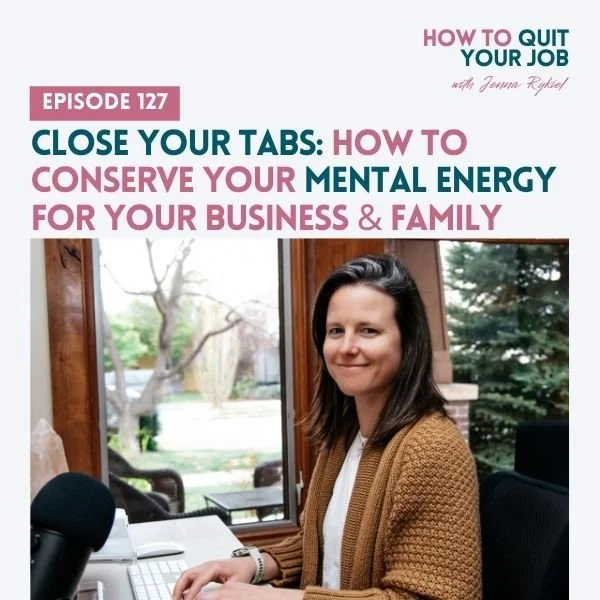
Have you ever been in the middle of something and suddenly remembered the permission slip you need to sign, the birthday text you forgot to send, or the thing you need to buy for your kid’s school party? Those little reminders have a way of popping into our heads at the least convenient times.
And even when the tasks themselves are small, carrying all of them around can take up a surprising amount of mental energy. In this episode, I share what I’ve learned from thinking about those unfinished tasks as open tabs in our brains, and why closing some of them can help us conserve energy for our businesses, our families, and the things that matter.
I also talk about the physical tabs on your computer, including why keeping your email open can interrupt your focus, and the end-of-day practice I’ve used for years to close out my tabs and start fresh.
If you're looking for the right environment to start your networking journey, look no further than my group, the Mom Entrepreneur’s Circle. Sign up here for mutual support, advice sharing, and the tools you need for both you and your business to thrive.
What You’ll Learn from this Episode:
How unfinished tasks can become open tabs in your brain and consume mental energy.
How taking care of small tasks can give you back energy you’ve been spending thinking about them.
Why keeping multiple physical tabs open on your computer can make it harder to focus.
How keeping your email open throughout the day can lead to constant interruptions and task switching.
How to give your online tabs a place to live without keeping them open on your screen.
The end-of-day practice I use to close out my tabs and start fresh.
Listen to the Full Episode:
Featured on the Show:
Click here for step-by-step instructions to leave a rating and review to let me know what you think, and don’t forget to share the podcast with others who you think would benefit!
Ready for clarity and a simple action plan to get your business started? Schedule a free 1-hour consultation with me here!
Episodes Related to How to Conserve Your Mental Energy for Your Business & Family:
23. Procrastination Tips: Push Through Resistance & Get Things Done
111. How Moms Can Shift Victim Mentality & Manage Mental Load with Zahra Premji
Full Episode Transcript:
I know it sounds too good to be true, and it's simple. But sometimes it's the smallest shifts that make the biggest difference in our day-to-day. And today, I want to talk about one of those things, and I want to challenge you to rethink something that you probably do every single day.
Welcome to How to Quit Your Job, the podcast for moms ready to ditch the nine-to-five and build a life and business they love. I’m your host, Jenna Rykiel. Let’s go.
Hi, mom friends. This is episode 127 of the How to Quit Your Job podcast, a mom's guide to creating a life and business you love. Before we dive in to the good stuff, this is one of those rare occasions, rare recordings that I'm doing after bedtime. If you've been following the podcast at all, you've probably heard me mention that I really don't love working after bedtime. I never encourage my clients to do that. Our brain is just not at its best. Thankfully, I created all of my notes and my script prior to this moment.
So, all of the bulk of the thinking has already been done. But this is one of those rare occasions where I am cuddled up with chamomile tea. One of my children is still fighting sleep, so you may hear him on the monitor in the background.
It's a night of solo parenting, of course. So, that's just my life that I'm living over here. It's been a pretty chaotic week. My oldest son came home from school sick on Monday, stayed home Tuesday, stayed home Wednesday, which is today. And so it has just been chaotic. And I'm sharing that because sometimes it's helpful to process that and say it out loud, but also just to say, I'm right here with you in the chaos of parenting, especially parenting with little kiddos and trying to do it all. So, I see you. And please send me good vibes for my oldest son Adley to go to school tomorrow. He's four. And please send me good vibes, even though at the time that you're listening to this, all these things will have passed. But also send me good vibes that my youngest, who's two, Jude, falls asleep so we can record this.
Okay. Anyway, this week's episode that I had planned out previously is going to be a little fun, or at least what I deem fun, because this is one of those kind of short and sweet concepts that can truly be life-changing. So, how about that? This idea that I'm going to talk about came from two different sources converging. And sometimes when that happens, I'm like, of course, I'm going to do a podcast episode about this.
So, the first was an interview with Zahra on the podcast in episode 111, where we talked about the mental load that we carry as moms. And I loved so many things that she said, but one thing that I really want to share again in this episode is that she said the responsibilities we carry aren't necessarily optional, but how we handle the load can be. Okay?
We have these incredible skill sets as moms. We manage multiple things, we pivot quickly, we adapt, we anticipate other people's needs. But we don't want to use those skills against ourselves by keeping everything running as open tabs in our minds all the time. Okay, we have a lot of responsibilities and when they are all just swimming around in our brains as these open tabs, that's where the problem lies. So, definitely check out episode 111. I'll link it in the show notes for this episode.
Okay, so that was the first thing that happened. Now, the second thing that happened, in one of my group coaching sessions with my clients, we meet weekly as a group. We were having a conversation about the tabs on one of my client's computers, and she admitted that she always has like 30 to 100 tabs open. Okay, we were kind of laughing about it, but this is notable. Like 30 tabs, 100 tabs, that is something for us to look into. And that's when these two ideas converged. Okay?
The metaphorical tabs that we keep open in our brains and the literal tabs we keep open on our computers. And today I want to talk about both, because I think the metaphor is really important, and I also think the physical act of closing out tabs on our computer can also be life-changing. It's something that I have practiced and tested out myself for many years, and I can't believe that I don't share it more often.
So, if you're a big tab person, if you like having a lot of tabs open, I want you to bear with me. Hear me out. Nothing I ever talk about is a requirement, but I do want to encourage you to accept being challenged on this and maybe stretch yourself a little bit.
So, let's talk about the tabs in our brains first. I want to expand on what Zahra and I talked about. So, we have a lot on our plates as moms and humans. We have a ton of responsibilities, and each of those things can feel exponentially more stressful when we're holding onto them in our heads. I want to give you two strategies for closing out those mental tabs. And then we're going to dive into those physical tabs, because I really don't think we're talking about that enough. So, we're going to start today. The first thing, the first tool for closing out those mental tabs, is that everything we have to do either lives in our brains or lives on multiple to-do lists scattered around.
We write things down, maybe in the moment, we kind of keep track of them. And even if we have good systems, there's still a degree of things living in our heads. I have great systems and there are still things that are taking up mental space in my head. You will know this is happening for you and to what degree it's a problem, if randomly throughout the day or especially right before bed or in the middle of the night, something pops in your head that you need to think about or need to do. Like, boom, I forgot to sign that permission slip. Or, oh my gosh, I have to buy that thing for the Halloween party. Or, oh goodness, I forgot to text so and so on their birthday. These things pop into your head at times that probably aren't great. And if that's happening to any degree, it may be a sign that you have some tabs open in your brain that need to be closed.
So, how do we close them? One of the simple ways that we close them is that we actually write things down. And we also kind of truly decide when we're going to get them done. Not just writing them on a never-ending to-do list and then randomly pulling that list out whenever we have 10 or 30 minutes to spare. I mean actually knowing the moment in your week when you're going to do that thing that keeps popping up in your head. This takes some scheduling. And I know that for some of us, especially if scheduling is something we struggle with, that's easier said than done. But I promise you, when you know when you're going to get something done, when you've set aside time to do that thing, even if it's a block of time to do 20 little things at once over the course of an hour or two, there is a sense of peace that happens.
You may not necessarily feel it tangibly in the moment, but I guarantee you, if you get used to having things scheduled into your calendar when you are going to do them, and you get into the habit of actually doing them, which is a whole other episode, but when you have these things scheduled and out of your head, there is a sense of peace that comes and it doesn't keep popping into your head. The first couple times you do this, they will pop into your head. And then you'll say, "Oh, look, I already have that scheduled. I know I'm going to do that tomorrow during my lunch break." Okay, your brain's like, "Good, I know when that's going to get done." So, that's the first thing to close out these tabs. Okay?
The second thing, and it's really part of the same strategy, it just is a partner in crime to it, is to just do the things. There's that concept, "Eat the frog," about doing the thing you don't want to do and getting it out of the way. It's kind of like that. I want you to actually take care of the tasks, especially the easy tasks that you've been carrying around for way too long.
I have this lovely, wonderful client. When she started working with me about six months ago, she had a whole list of things she wanted to get done. A lot of them were pretty basic things, like booking trips and things around the house, seasonal things, things in her business. She's gotten through a lot of that list with the tools that I teach, with scheduling things. We've also deleted some of the things that don't actually matter. But there was this one task of booking flights for her family for a trip. And as I record this today, I still don't know that she's booked the flights. And it's October. Winter is coming.
And I guarantee you, every time she remembers that she hasn't booked those flights, it zaps energy. I know that 100% for certainty because in a number of our sessions, that trip has been brought up and the flights not being booked has been brought up. So not only is it taking up mental energy, it's also taking up coaching time that it comes up. It's taking up space. Okay? She's reminded of that tab being open in her brain, and open tabs consume energy. And all she has to do is book the flights. Maybe it's a 10 or 15 minute task.
Now, I know that's a loaded request, this request to just do the thing, because there are thoughts and decisions that go into even one little action. But I want to encourage you to limit as much of the mental drama that goes along with each task. I want you to trust yourself. That could be a whole episode on its own. I know, and I've talked about these concepts before in decision-making, but I want you to trust yourself and your first instinct on some of these decisions, I want you to go with. I recorded an episode, and actually we just talked about it today in our group call. I talked about how so often our first inkling in what we should do, what flights we should book, is usually what we end up going with in the end. But we feel like we have to do some sort of due diligence before we actually make that decision. Like, if it's too easy, it feels wrong.
So, we have to log on to multiple airline websites. We see that first flight, we're like, "Oh my gosh, that looks pretty good." And then we start questioning ourselves. Let me look at the other options. Let me look at other deals. Maybe I should wait, right? People say Tuesday is the best day to book flights. So let me, today is Thursday, so let me wait until next Tuesday to actually do it. And in all those delays, that tab stays open in our brain. And that costs us time and energy, not to mention the tab on our computer to Southwest or Delta or whatever also stays open, which I will get to in a second and I can't wait to get to and talk about.
So, it's not just the time it takes to book the flight, but all the energy that we spend thinking about booking the flight. Our brain is always working, but it could be working a whole lot less on these little things if we weren't keeping all those tabs open, if we were just booking the flight. I don't care if prices go down. What is the cost of keeping that tab open, losing sleep because it pops into our head at 3 a.m., thinking about it randomly in the car, and judging ourselves for not having done it yet? All of that takes energy.
And then what happens when so much of our energy is depleted on these open tab tasks that we could have just closed out in 10 to 15 minutes or less? When all of those mental tabs are open, we don't have the mental capacity for our businesses. We also sadly don't have the mental capacity for our kids. And I know that feels a little extreme to say, but many of us have a lot of mental tabs that are open right now, things that have been building, that we haven't gotten done, that we're judging ourselves for not doing, and that get harder and harder to actually do as each day goes by.
So, we don't have the mental capacity for our kids, our partners. We're snippy with them. We're carrying all of these unfinished things around. We've got too many tabs open in our minds. So, that's the analogy piece. We want to get things out of our brains, decide when we're going to do them, and actually get them done. Okay? Close those mental tabs.
The second thing I want to talk about are those literal tabs. Anybody who has worked in corporate for any amount of time, especially, knows what I'm talking about here. We keep multiple tabs open on our computer. And I get it. That was me. And I think we do it because we believe it's a way to keep ourselves on track so we don't forget things. We almost look at it as like a to-do list on our computer. We have the flight we selected open, so we remember to come back and book it once Tuesday rolls around or after we chat with our partner about the dates and times. Or a form that's halfway filled out that we'll come back to tomorrow. This was actually something I just recently did and caught myself.
Or an article that we want to read. This is a lot of my clients and my husband. And we keep that tab open on our computer, even when we close our laptop, because we don't want to forget. When we open our laptop the next day, we want that tab to be on there so that it reminds us to read the article, book the flight, whatever it is. And here's what I want to suggest. Keeping those tabs open actually consumes way more energy than it's worth to track what we want to be doing.
Instead, what I would much rather you do is capture whatever that tab represents as an actual task, write it down, decide when you're going to get it done, and schedule it. Even if it's something like reading an article, I'm actually not a big article reader, which the more I talk about this, because I've talked about it a little bit more recently, the more I realize how odd this might be. I have never been able to read articles on the internet, online. I'm a big reader of books, printed out articles. I cannot scroll online and read articles. I have like an aversion to it. But I know a lot of people keep tabs open because they want to read something on the internet.
Here's what I suggest. Either print out the article or copy the link and put it in your calendar. So, you might say, "Oh, I don't have time to read this now. But tomorrow morning when I'm drinking my coffee, after I drop off the kids, I'm going to read this article. I really want to read this article." So, let me go ahead and put it in my calendar for 8:30 a.m. to 9 a.m. and make myself a mental note, an actual physical calendar note to remind myself to read this article. Let me maybe print out the article and put it next to the coffee machine, so I remember that I want to read this as I'm drinking my coffee.
Create a calendar event and put that link in there so that you actually remember and that you give yourself that time. And delight in having the time to read that article. Once that event is in your calendar or successfully marked down or you have your way of reminding yourself when and where you're going to read that article, close out the tab. You haven't lost the article, I promise. You've just given it a place to live that isn't sitting open on your screen competing for your attention at every moment.
I want you to do this with every tab, even my 30 to 100 tab folks. I promise there will be a sense of joy, a dopamine hit that comes with closing out tabs when you feel really good about it, right? When you know that you are not giving up on that article, you are not giving up on that form, you are not giving up on that flight. You are just finding a better time and place to actually get it done. When the tabs are up on our computer, they are taking our attention away from whatever our task is. What they also do is they secretly make us feel really bad. They remind us of all the things that we haven't done. Okay?
This is also what a to-do list does. I have an episode from the very beginning, episode 12, "How to Finally Take Control of Your To-Do List," which talks about a very similar concept, which is that we think these to-do lists are helpful. We think this tab list is helpful in keeping us on track and telling us what we want to do. But actually what it does is it's never ending. It never gets completely closed out. And it just reminds us of how incapable of finishing these things we are. It reminds us of everything we have to do. It's super overwhelming. The more tabs we have, the more things on our to-do list we have, the more overwhelmed we feel. It really does make us feel shitty. I promise.
Another suggestion for tab closing is specifically with our email tab. This deserves its own conversation because I want you to, like, whatever your journey is with all the other tabs that are open on your computer, close them out, don't close them out, close some of them out, make some progress, you know, take some of this in, leave the rest, whatever feels best. But specifically with your email tab, I really want you to close that one out. I want you to close out your email tab throughout the day. I want you to decide when you're going to check your email. Okay?
Once a day, twice a day, three times a day. It doesn't matter how many times. I just want that tab to be closed when you're not actually using it. And this has always been the hardest one for me. I'm still working on it. The majority of the time my email is open. Now, emails aren't coming in like wildfire like they were when I was in corporate, right? You know how corporate is. It's like every three seconds you're on a company email, a group email, a reply all, it's madness. But even now, I still find myself leaving email open. There's a really real corporate habit that has stuck with me.
I don't want you to be able to see emails coming in while you're trying to focus on something else, because when information is constantly changing on the screen, it's distracting. Okay? And let me tell you what usually happens. You see that number pop up in your email tab. You know, as soon as you get a new email, an unread email, that number pops up or that number changes if you're someone who keeps a lot of unread emails open, you know what the number is, you see it change, right? So, you go to that tab, you see the email that came in, that bold new email. You may or may not click on it.
Either way, you've already interrupted what you were doing. You've switched from whatever task you were on. There's research on how costly those interruptions and task switching can be for our focus. I think it's something like 20 minutes to get you back focused on the task at hand. And I think we all know what that feels like. So, you switch over to one thing and suddenly you're trying to then remember where you were and what you were doing on the previous tasks. You kind of feel like you're floating. The whole day feels much more chaotic, right?
And you don't realize that it's just a bunch of going back and forth, and that can be solved just by deciding that when you're working on one tab, let's say, you're sticking with that tab. You're not switching to others. If you're navigating a full-time job, motherhood, family responsibilities, and starting your own business, you really can't afford to be distracted by this bad habit. Having your email up and checking it constantly is a bad habit. And I'm preaching to myself here because I'm right there with you.
I will say though, I've tested what it feels like to check email in the morning, at lunch, and before I sign off for the day. And it is a beautiful thing. Yes, sometimes I miss an email from a client, maybe saying they're going to be late for a session or they need to reschedule last minute. Sometimes there's time sensitive emails that I might miss and that's okay. If something is truly urgent, people will find a way to get in touch with you. Somehow, preschool always gets in touch with me. If something is truly urgent, they will get in touch with you.
What we gain from not having email open all day is so much more focus. We get so much more done. So, that's my second suggestion for your computer. Close the email tab, and decide when you're going to open it. Do not treat it as this open communication line like a text message. Really decide and take ownership over your time that you get to check your email and you get to respond to emails when it's right for you.
Now, this other thing that I want to float is just an idea. This one's a little bit more extreme. You can test it out or not test it out. It's up to you. I'm sure I've given you a lot to noodle on and that maybe you want to test out and maybe you want to punch me in the face, which anything is fine. But this one is something that I started testing because I found that having tabs open at the end of the day and starting my day with a bunch of tabs open was really not healthy for me and was also kind of confusing. It actually consumed a lot of energy.
So, what if at the end of the day, no matter where you're at in your day, what you've completed, what is incomplete, you closed out all of your tabs in one fell swoop? There is a red X button in the top corner that just closes out the internet entirely. And what if at the end of the day, you just clicked that red X and didn't give too much thought to what you might be missing?
This is a more aggressive challenge, but this has actually been my process, like I was saying, for quite a few years now. Even while I was in corporate, I realized that at the end of the day, the end of every work day, I would leave all my tabs open. Then I'd log in the next day and I'd look at those tabs and I'd be kind of confused and I'd spend a lot of time trying to prioritize and thinking about where I was with each of them. And I'd think, "I don't have time to deal with these right now. I have other things I need to do, meetings I need to be at, a plan for what I need to get done today."
So, then I'd actually open even more tabs and I wouldn't close those out either. And then the next day the same thing. They just kept hanging around and growing like a chaotic to-do list. So, what I started doing was at the end of the day, I'd look at all those tabs and ask myself, "Is there anything here that's so important that I need to write it down?" And if there was, I'd capture it. I'd write it down, I'd put it in my calendar. I would decide if there was time later in the week to actually get to it or maybe time, you know, after work hours, if it was something personal. And if there wasn't anything that was important enough to really write down and schedule in my schedule, I would just close out all the tabs, no matter how many there were. It used to be somewhere around 15 to 20. Now it's usually somewhere around three or four. I've gotten much better at this.
But every day, when I am ready to close my laptop, I click that red X. I would just do it without overthinking and trust that tomorrow is another day and I'm going to start fresh and I'm going to be fine. And I want you to try that. If you're too scared to do that, to let go of those tabs, that's okay. You can go through each tab, capture what you wanted to do with it, add it to your to-do list, schedule it on your calendar and then maybe close it out. Maybe you do that with half of the tabs or a third of the tabs or whatever works for your desktop, whatever works for your life.
But if you want to be brave, join me in be brave and just click that red X at the end of the day and close them all out. This is my hot take on tabs. I talk about tabs in passing so often, and it kind of seems silly, I guess, but I don't think we are actually talking about how important it is to close these things out on our mental health. I want you to close out as many tabs as you can in your brain for your mental load, and I want you to close out as many tabs as you can on your computer. I want you to be able to focus. I want you to be able to conserve energy for the things that matter. Energy is at a premium, especially when you're a mom who's managing a career, a family, trying to build a business and all the things. And I think you'll be pretty amazed at what this small shift actually does for your energy.
As always, you don't have to do it perfectly. You don't even have to do it at all. Just test it out, see what works for you, and let me know how it goes. You can always email me and share what's working and not working for you at jenna@jenna.coach. Let me know how it goes. And after this, I will be closing my tabs for the night. All right, mamas. I'll talk to you next week.
Thanks for listening to this week’s episode of How to Quit Your Job: A Mom’s Guide to Creating a Life and Business You Love. If you want to learn more about how I can help you stop making excuses and start making moves, head on over to www.jenna.coach. I’ll see you next week.
Enjoy the Show?
Don’t miss an episode, follow the podcast on Spotify, Apple Podcasts, or RSS.