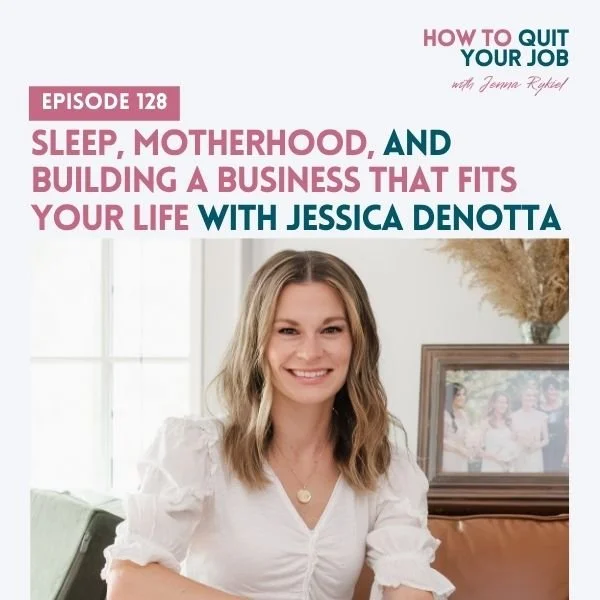
You can love being a mom and still want something that challenges you, gives you a sense of accomplishment, and is yours. But building a business around motherhood also means being honest about the season of life you’re in, including how much time, energy, and sleep you actually have.
In this episode, I’m joined by my friend and past coaching client Jessica DeNotta, founder of Childhood by Design. Jessica shares how she went from being an elementary school teacher and mom of four to building her own business as a sleep consultant. We talk about how she realized her first business idea wasn’t the right fit, why changing direction wasn’t a waste of time, and how paying attention to what people were already coming to her for helped her find the business that fit her life.
We also spend a lot of time talking about sleep and why it matters so much when you’re trying to build a business as a mom. Jessica explains her approach to sleep teaching, why every child and family needs something different, and why sleep challenges are about more than what happens at bedtime. We talk about the role of routines, consistency, getting support when you need it, and how better sleep can give you more clarity and capacity for the things you want to do.
If you're looking for the right environment to start your networking journey, look no further than my group, the Mom Entrepreneur’s Circle. Sign up here for mutual support, advice sharing, and the tools you need for both you and your business to thrive.
What You’ll Learn from this Episode:
Why you don’t have to know exactly what your business should be before you start.
How to recognize when a business idea isn’t the right fit, even when it’s starting to work.
Why the skills you develop in one business can make your next business easier to build.
How to look at what people already come to you for as clues about your strengths and possible business ideas.
Why it’s important to consider your current season of life when deciding what kind of business to build.
How sleep teaching can be about much more than what happens at bedtime.
Why getting support with your child’s sleep is not a sign that you’re failing as a mom.
Listen to the Full Episode:
Featured on the Show:
Click here for step-by-step instructions to leave a rating and review to let me know what you think, and don’t forget to share the podcast with others who you think would benefit!
Ready for clarity and a simple action plan to get your business started? Schedule a free 1-hour consultation with me here!
Episodes Related to Sleep, Motherhood, and Building a Business That Fits Your Life:
Full Episode Transcript:
Welcome to How to Quit Your Job, the podcast for moms ready to ditch the nine-to-five and build a life and business they love. I’m your host, Jenna Rykiel. Let’s go.
What happens when you've spent years building a career, doing everything you're supposed to do, and then you become a mom and realize that the career you've worked so hard for doesn't actually fit the life you want anymore? And what happens when you finally get the courage to start your business, only to realize that the business you started isn't quite right either? Do you keep pushing because you've already invested so much time into it, or do you give yourself permission to change direction?
Today, we're talking about all of that, and we're also talking about something that I think is one of the biggest, most underrated pieces of building a business as a mom: sleep. I don't care how motivated you are or how amazing your business idea is, if you're exhausted, if your kids aren't sleeping, and you don't have any time or energy to yourself, building a business is going to feel a whole lot harder than it needs to be. It's going to feel impossible. And that's why I'm so, so excited about today's conversation.
My guest is Jess DeNotta, founder of Childhood by Design. She's a sleep consultant that helps families with babies and toddlers establish healthier sleep habits and routines. Jess is also a former elementary school teacher with a Master's degree in education. She's a mom of four and a past coaching client of mine. After having her third child, Jess stepped away from teaching. With her husband working long hours outside of the home, going back to the classroom just didn't make sense for her family anymore. But she also knew she wasn't done working. She loves being a mom, but she wanted something that was hers, something that challenged her, allowed her to use her skills, and gave her a sense of accomplishment outside of motherhood. And I know so many of you listening can relate to that.
So, Jess and I started working together to figure out what building a business could look like for her. And here's where her story gets really interesting and why I am so inspired to share her story. The business she has today is not the business she started with. She initially pursued a very different idea. She put real effort into it, and she even started getting clients, but something wasn't right. In fact, Jess talks about something within this conversation that I think is going to stick with a lot of you. At least, I hope so: that the more business she got, the more successful she got, the more wrong that business felt. And this in general is such an important piece.
If you're someone who's afraid to start a business because you're worried about choosing the wrong idea, Jess's story is such an important reminder that you don't have to have everything figured out before you begin for it to work out. Sometimes, you just have to try something to discover what actually works for you and what doesn't work for you. We talk about what made her decide to pivot, how she recognized that some people coming to her for simple advice, there was a pattern of it for years, and how that could actually become a business, and what she's learned along the way that I think will be helpful for everyone.
But of course, we also spend a lot of time talking about sleep. And I love Jess's approach, especially her use of the term sleep training, which we get into. With her background in education, she approaches sleep as a skill that children can learn with support, structure, and an understanding that every child and family is different. She honors that, and I love it. We get into the common and some of the biggest misconceptions around sleep training, why sleep challenges aren't always just about bedtime, and how better sleep can make such a difference for the entire family.
And here's why I think this conversation and talking about sleep matters so much for you as a mom who's building a business. When I work with moms, we're not just talking about business plans and marketing strategies. We're talking about your actual life: your time, your energy, your routines, and what needs to change or be improved to make space for something new, to make space for building a business. Sometimes, the thing that's going to make the biggest difference in your ability to build a successful business is not another productivity hack. Sometimes, it's getting everyone in your house to sleep better.
So whether you're struggling with your child's sleep, thinking about leaving your traditional career and not sure what to decide, or questioning whether the business you've started is actually the right one, I think you're going to take so much away from this conversation. And I hope Jess's story reminds you that you don't have to get it right the first time. You just have to be willing to start, learn, and keep going along the way. So let's get into my conversation with Jess from Childhood by Design.
—
Jenna: Hi, Jess. Thank you so much for being on the podcast. I am very excited to talk to you today. I've been thinking about this conversation for probably six months to a year, maybe. I haven't had a lot of clients, past clients, on the podcast, but I really think this conversation and you sharing your expertise and a little bit about your story is going to be so important for listeners. So I want to start more generally and talk about what is sleep training. Can you define it for us simply? Can you talk about how you think about it?
Jess: Yeah, and thanks for having me. I'm excited to be here. I know we have talked about this for a while, and when you hear the word sleep training, I think that there is a big misconception about what that actually means, and of course, speaking to babies and toddlers. I think that often when I speak with not even clients, but just even friends, family, people on the soccer field, you hear sleep training, and I think often what pops into people's head is this idea of, well, you're going to let your kid cry it out all night long, and it's going to be really difficult, and it's going to be miserable. You're going to traumatize your child. And I think there's a really negative association with when you hear, "I'm going to be sleep training." I think it's also one of those things that it's like taboo to ask about. Are you going to be sleep training your child? It's in a negative way.
And the way that I see it is completely different. I use the comparison a lot with clients and friends and family of, are you going to be asking, "Are you going to teach your kid how to tie their shoes? Are you really going to be like sitting down with them and being like, you loop it first?" And that sounds so silly, but I think this is similar that babies, you hear about the babies that sleep within the first week or in that second week, and that's great, and that's good for those parents. But there are babies and toddlers who haven't been taught that skill or who are just not naturally going to do that on their own. And that's our job as a parent to teach that. So I think even rebranding the word sleep training to sleep teaching is really how I feel about that, where to me, sleep training or sleep teaching is teaching your child that they have the ability, they have support from you, they are loved, they are safe, and sleep is good for their bodies, and they can put themselves to sleep all by themselves and really creating that positive association with getting a restful sleep, enjoying our cribs, enjoying our beds, and that it's good for them.
And also that the parents, something in the mindset there that needs to shift that we can take the time out to teach our child these skills without it being a totally miserable experience. Will there be habits to break? Sure, of course there are. But really, sleep training to me is getting that rhythm in your day, during the day and night, and establishing structures in your house where your child likes going to bed and it's a positive experience. And you get to go on a date night because you can hire a babysitter or because the structure and the rhythms in your house are set. So to me, I think it's a much more positive experience, especially when you have support, someone helping you along the way, and that's really my kind of long-winded answer of what comes to my head, why I'm so passionate about it.
Jenna: So my husband and I very early on in our parenting journey have always said, well, mainly he has said this, but he said, "Sleep is the greatest gift that you can give a child, and it's the greatest gift that you can give the parents." And I think that wholeheartedly. And one of the things that I'm especially excited about with this conversation is sleep is also such an important part of my mom's starting businesses. I talk to moms about finding time in their day and being rested and when your brain is operating most optimally, and it's really hard when there are really bad sleep habits happening. And it spans the gamut of different things that could be happening depending on the kid's age.
But not that I have expertise to share with them, but I see the other side of it of what can happen to our goals and our dreams when we don't have that piece figured out, when we are up multiple times a night, maybe unnecessarily, or when we are having to wake up with our toddlers in our bed and restart the day not having our own moments or not being able to work out or not being able to do our own thing. It really is one of those things where I tell my clients all the time, this is a part of the process. This is actually a part of coaching that we need to figure this out because like you said, it's such an important skill that kids develop this independence and this autonomy and the skill of being alone and comfortable in their room and knowing that they're safe. I also love that you say sleep teaching instead of sleep training. I haven't heard that before, and I love it too because you come from a teaching background.
Jess: Yes.
Jenna: You want to talk a little bit about how building your initial, maybe traditional career in teaching has made or maybe impacted how you approach sleep teaching, sleep training, and maybe how it inspired it at all?
Jess: Yeah, no, it definitely has helped how I help families. I have a Master's in education. I have a decade worth of experience in elementary education, and it really prepared me to meet families where they're at. And I think that because I've been doing that for so long and I also am very aware that every child is different, just like it was in the classroom, same with my clients here, that yes, the struggles can be similar, but there is no family that's exactly the same. There is no child that is exactly the same. And so I think that going in with that mentality has been really helpful. I also believe that when I teach clients how to help their children sleep, I definitely also look at the bigger picture where I have seen other sleep plans or people who have had other sleep training experience where they really only talk about, "Okay, like when it's time for bed, you do X, Y, or Z."
And I warn my clients beforehand that my meetings are a little bit longer because we talk about the daytime too, where to me, when we're teaching our child how to sleep, it starts as soon as they wake up in the morning. I am infusing positive language. I'm looking at their sleep environment. I'm looking at their siblings. What are they doing? How are they handling this transition? And I've had clients that are like, "I never really thought of it that way. I didn't think that this would affect how he or she is sleeping at night." And that matters so much, the way that we speak to our littles about sleep. We have no idea the impact that makes when our child is hearing us vent to our family on the phone. Oh, they got up 12 times last night or, "You're going to be babysitting them. Good luck. They get out a million times." And they hear that and it becomes, "Well, I guess that's what I'm supposed to be doing," because mom keeps saying that. And that stuff matters. And it's not a failure on our part. We're so exhausted, you know, we're finding support and talking about that with others.
But all of that, to me, when I'm teaching clients how to get their child to sleep, like all of that matters: positive reinforcement, looking at even just the routine where are we eating when we should be eating and are we then not eating when we shouldn't be? All of that matters. And I think that's why a lot of my clients have such fast success because you do that for a few days, and without fail, my clients are like, "Oh, they're actually having less meltdowns," or, "Oh, at daycare now, they just took a two-hour nap because we shifted something here." So it really goes beyond just, "Okay, now it's 7 o clock at night. We're going to get out this magic tool that's going to get your child to sleep." No, there are so many other factors to consider there, and I think being in the classroom and talking with so many families and you know, my job has always been, "How do kids learn best? What motivates a child? We really need to honor every child is unique," and I think that really just carried over into this position really nicely. And I see it making a big difference in this work too.
Jenna: Yeah. I love that you say no child is exactly the same because what I hear so often with clients or with friends or with family is them saying like, "No, my child is different. Like, it just doesn't work for my kid because he's this or she's that or they like this or they like that." And I love that you recognize that and you lean into it of like, of course every child is different. And that's why the process itself is so individualized and it's so much bigger than just this moment of sleep at 6 p.m. or 6:30 or 7 or whenever the bedtime process starts. It's like, well, no, we're going to honor the differences, and we're going to lean into them and make sure they're a part of the process. I absolutely love that.
I also love you saying sleep starts when they wake up. I think that's brilliant. It's like, of course we don't naturally think to start talking about sleep in a positive way when they wake up in the morning and maybe had a rough night or came into the room a few times or they were crying at night. It's like, we respond almost with a reactive nature because we are tired and we are thinking about everything that we have to do that day. But I think that's why, and I know you agree, like support and guidance on this is so important because we don't have all the answers as parents. There isn't a great guidebook. And any guidebook that there is, I know I talked about like on one of the first episodes, I reference Moms on Call because that was a book that we read and we did sleep training with it. It worked like magic, right? But when you have multiple kids or the more your kids are changing, there is no guidebook because of the fact that every kid is different. And so I almost think of what you do is like almost like a concierge service for sleep.
Jess: 100%. And even me having four kids, even they are also different. I had to treat each one of them in a different way. And you know, a lot of the methods were the same. Yes. Like, did I use certain things with each child? Yes. But there was a way even I would shush my first that I, that would just make my third mad. It's every kid is so different, and they're so different at every age. How you handle a one-year-old is a lot different than how you handle a two-year-old, which is a lot different than how you handle a two-year-old and two months. So yes, like it's definitely not a one-size-fits-all.
Jenna: So I want to talk a little bit about how you came into this business because I know we're probably hearing, we probably have people listening who come from maybe a teaching background, they come from a school role, or even any traditional role. But this is something that I would only imagine was not like necessarily on your bingo card when you were in the classroom per se. And I think it evolved really beautifully in a way that I just want us to talk about a little bit because it's one of the things I hear most often with my clients is that they don't want to choose the wrong business. They spend a lot of time brainstorming. I know we spent a lot of time brainstorming, but there is this fear that I'm going to waste a lot of time and mess up and choose the wrong thing. So can you talk a little bit about how being a sleep consultant came to be?
Jess: Yeah, I mean, definitely a recovering perfectionist, always will be. Yeah. So I was, like I said, I was in the classroom before this, and with every child, it got a little harder to be working out of the home full-time. I'm in a situation where my husband works out of the house. He's out sun up, sun down, and so I solo parent a lot Monday through Friday, and it just wasn't sustainable anymore. And I left after having my third and took some time off, had one more, and then was, I was done having kids, and was like, "Now what?" And thinking about going back into the classroom just wasn't a sustainable option at that time, but I so badly wanted to work. I wanted something that was fulfilling for me. As much as I am fulfilled with my four kids, I know I'm not alone with this message that a lot of moms who are home are smart, capable women who on a Friday night would love to have a glass of wine with their partner and talk about the things that they did that week that had nothing to do with the kids, that their brains did and were proud of.
And so that's how I met you, Jenna. And we really together were like, "How can we start something of my own?" Because I knew it had to be flexible. I knew that I wanted to start something that I could turn on one day and turn off another if I needed to. Four young kids, it's a very demanding job in and of itself, so I knew my commitment. I knew what I was able to commit to. And so we took a deep dive into my interests, my talents, and if I really were to look back, the signs were always there, even in the classroom. My classroom became the area where people would go and ask about sleep. If I really were to think about when did this start, I even remember a supervisor knew I had a prep and was like, "Okay, we're going to take your prep now. Why is my kid getting up at this hour?" And we really went into it. So I think sleep was something that I was passionate about, but I did not know how I could make that a business.
And so when I started, I was really kind of overwhelmed with how many options there were with business ideas. And also when my mind was opened to you can kind of do whatever you want, that was incredibly overwhelming for me. I have passions of interior design. I love kids' spaces. I love curating certain things in an educational space. Like there were a lot of things that I was really, really interested in, and it was really paralyzing to pick one. So that was definitely an experimental phase that I needed to go through. And I had originally picked a different idea, still in the field of kids and structures and routines and I found as I kept kind of pushing that forward, it didn't always feel right. And as woo-woo as it sounds, I knew it. You feel it in your gut. If you get quiet enough, you can hear it.
And I just was like, "You know what, sleeping..." And you know, Jenna, you and I had talked about this. You know, sleeping is something that even when I was trying to do this other business, people would be like, "My sister just told me that you're great at sleeping. Like, can you help me?" Or I would get calls from cousins, and I happened to get a phone call from a family member that was like, "Hey, Jess, my two-year-old," and gave her a story about they weren't sleeping through the night. And something just clicked that was like, "Treat her like a client. You have done a lot of work on what a business looks like. You've done a lot of things to establish that you are interested in starting your own business." And I just kind of switched the topic. I kept everything that I've already made. You know, I had done like an Instagram platform, a website I'd started, and I'd done a lot of work, and I just plugged in sleeping instead. And no one cared, like I thought that they would. I think that we tell ourselves a lot of stories that like if we change, it's going to be humiliating, and you know, our worlds are going to come crashing down around us, and no one cared. They were like, "Oh, great, you can get kids to sleep. I would like some of that." And that was it.
So I feel like when you feel that something's not right, I think it's important to give it some time, and that was hard for me. I was like, "No, I committed to this. I need to give this some time to see how this will shake out." I worked with some clients, and it just never felt right, especially when it was starting to work. I was starting to get more business, and the more business I got, the more wrong it felt. And at some point, I just had to listen to it, and I switched, and all that noise evaporated. So I think it's okay to just switch and then know when that's right. And you can still use what you did before because people aren't paying as close of attention as you think that they are.
Jenna: That's such a good point that the noise got louder as you got more successful because we want to not necessarily run from something that feels hard or scary. So we need to be able to really decide like, "Is this my intuition telling me like this just isn't the right business now that I'm in it, or is it fear that's trying to drive the bus and is scared and doesn't want to keep doing this?" And I think you said it so perfectly of like, "I was getting momentum. I was getting more clients in this other business, and it just continued to not feel right."
The beautiful thing, though, because I hear all the time, people are like, "Well, I don't want to waste time." And I'm sure maybe there's a part of you who, you know, would look back and be like, "Ah, wish I would have like started the sleep business at the very beginning, right? Saved myself 9, 10 months." But all of the skills, like all the things you developed in that initial business idea, even if you have to change the words of it, all of those skills stay with you. Like, it is such a big skill to learn and to gain confidence to charge people, right, which is something that you were doing. Even just learning how to do that and tell people what you're worth and decide what a price is and set up all of like the logistical things, all of that makes the transition into whatever is the next thing that maybe feels like it's the right thing at the time once you know more.
All of those things make it so much smoother, which I'm sure you felt that. Like there was a part of you that felt like, "Oh, this feels like home in the expertise that I'm sharing," but also you didn't have to do all the mental drama up again with, "Oh my gosh, I have to charge people, and what do I say? And am I worth this much?" Like all of that mental load was already taken care of in the first business. I really think it's never a waste of time. We get to where we're supposed to be, sometimes in a wider arc, but we get there, right? And I do think that another thing that's really important about your story is listening and observing what is happening in your environment.
I always ask the question like, "What do people come to you for? Like, what are people always gravitating towards you for? What are they asking you? What are you an expert in just in your personal life?" Because those are such good data for us to really see like something that we think is so run of the mill and so normal in our life is actually extraordinary in someone else's. And I know that's also why initially it went towards interior design in a sense too, because people always come to you for that. But just to say, like I think that there are no mistakes. There are no regrets. There's no wasted time. We're constantly learning, even if we are learning with one business, and then it's more streamlined to switch to the one that feels right.
Jess: Yeah. And even to kind of like add to that, I think a big part of mine too was the business that I was building, I would have also had needed to be in person a lot, where I was creating these kids spaces that doing that just from my home, there's only so far that you could take that. And as much as there are parts of that I loved, I loved the design part and the creating and it wasn't super different. I mean, sleep training, sleep teaching is different, but it was still in the field of kids. So I was able to kind of switch over some of that, but also I think it was really important to look at what you are able to give in your phase of life.
And I had to really reflect on, "I had these big ideas that still excite me, but how much time can you really realistically give that?" And I think the sleeping, like you said, people come to me anyway for that. It is much easier for me to be able to do that even while a kid is home or two kids or three kids or four kids are home because that is something that just comes more naturally, and I can do it over Zoom or on my phone. I can build that business around me being able to do that in pockets of time.
And I think for moms, it's really important to be really realistic about that and what you're able to give. And sometimes you might need to plan backwards from that, where when I would get stuck, I would really have to think about, "Okay, like what does my ideal day look like?" And it would be, "Okay, after drop-offs, I have two or three hours of focused time. I don't really have to go anywhere because that in itself takes time. I can be at my computer with a cup of coffee and doing really meaningful work and helping families and sleep teaching families to get their kids to sleep." Like really fit that bill. So I think that's also something to consider. And you know, maybe when my kids are older, you know, I'll be like, "Oh, maybe I can incorporate kid spaces back into my services." I don't - never say never, but I think that looking at your phase of life is also really important. And if you don't, sometimes you can be left frustrated or kind of stuck like it's either, or you could have gone the opposite. You know, hire more childcare or you kind of figure out then how to make that work. But being really realistic, I think, was also in my story really important.
Jenna: Well, I really hope that you eventually incorporate that business because I've mentioned the initial business on this podcast plenty of times because I just loved the idea so much because I was in a phase of my life where I was always like picking things up and spending so much time, whatever. So I really hope you do actually pick that back up in some way shape or form.
The other thing that I forgot to mention before that you reminded me of again is it's so important, and we underrate this, but to figure out what you don't want. We think about that as being wasted time or failure sometimes when it's like we figure out that, "Oh, I cannot be on site. Like, I cannot travel for this. I need to just be at my computer." And it's so valuable to figure out what we don't want. I say a lot we need to figure out what doesn't work, so we can figure out what does work. Same thing here, right? We need to figure out what doesn't work for our schedules, for our stage of life, for motherhood, for the ages of our kids, for our financial situation, like all of the things. We need to figure out what doesn't work so that we can figure out what does work for us.
And you said it at the beginning too, like the overwhelm piece is like, people might not think this is true, but you can actually create anything. Like you can build anything. And so like not building something that's going to make you less of the mom that you want to be or make you less present when you're trying to be there more or be there for pick up or be there for drop off or whatever it is, it's like we get to decide when we start our own business. And yeah, it takes time to figure that piece out and then develop it. But we do want to honor that. Just like you're saying, we want to figure out what's realistic, really respect what we - and honor what we want out of this business, and shape it to be what we need it to be.
Jess: No, it was really well put. Yes.
Jenna: Is there anything else you want to share about sleep specifically? Like, I think the tools that you've shared already, which maybe we didn't like put a pin in as a tool, but I think sleep starting when the kid wakes up is such a good tool, right? And how we talk about it and just watching ourselves and recognizing like how we are and talking about sleep, and are we supporting the sleep conversation at all times? Like I think that's a really good tool. Anything else that comes to mind that somebody who's listening who's like in the throes of either a little baby who's learning how to soothe themselves and how to be in their room and put themselves back to sleep or on the other side where toddler just went into a big bed and they keep getting out, like what would you say for those people who've been exasperated with their situations?
Jess: Yeah, I think two short notes kind of really pop into my head that are important for any age. I think the first is just picking something that you can be consistent with. And I think that is probably the hardest thing that a parent will do when it comes to changing the sleep habits of your child. And whether that is a book that you pick up, whether that's using AI, because AI is not a bad thing in my eyes, whether it's looking at a module online, whatever it is that you pick, stay consistent with it. I think that a lot of issues with babies and toddlers and kids and their sleep is inconsistency and not giving it enough time where we try one thing that we read from one article for one hour and it didn't work, so it will never work. Whatever it is that you pick, you need to give it some time and you need to ignore the noise of all the other stuff that you didn't pick. I think that is the most important message to be shared when it comes to getting your little one to sleep.
And the second is it's not embarrassing to reach out for help when it comes to your little one's sleep. I think that we glamorize the exhausted mom a little bit too much where you go to a birthday party or you see on Instagram or any show, it's like, "Oh, you haven't slept in five years, right?" And we like to talk about how tired we are and your kids getting up X amount of numbers every night. But there's nothing that's being done in that conversation. And I think that when we talk about hiring a lactation consultant or a feeding specialist or whatever it is because we know that those things are essential, you know, sleep is essential.
And I think that you are not failing as a mom when you're hiring someone to help you with this process because sleep is incredibly emotional. When you are sleep deprived, your brain is not running at full speed like it should be. Your thoughts are fragmented. You're emotional. We all know how that feels. You are just drained. And I think that we don't bat an eye with spending money on things that are, you know, essential, like it's going to the spa and stuff like that. Yes, all that matters, but so does sleep. And I think that hiring someone to help you get the sleep that you need is like the best investment that you'll have for your family. And it's not something that's like, "Oh, I failed."
Babies and toddlers are doing what they're supposed to be doing. They're testing boundaries. They may not know how to sleep automatically. And I think that we need to make that not so horrible and just be like, "Hey, yeah, they're doing exactly what they should be doing, so I just, I need some help. I'm not sure how to do this," and getting the support that you need when you're trying to get your little one to sleep is more about getting the support that you need.
I tell my clients, like, "You're passing that brick of stress onto me, where you're texting me in the morning when you're like, 'I'm really overwhelmed. I don't know if this is going to work.'" Like, and I'm going to be there to guide you through that process. And then it happens where then all of a sudden, my clients like forget to text me because their kids are sleeping, and all of a sudden they're not so stressed, and like their lives begin again. And I think that we need to normalize that sleep is something that we all need, and it's not just something that like we need to have be really, really difficult just because we have kids. It's a choice that we can make that we're going to get through this and you know, figure out a way how to help with it rather than just suffer through it. So I think that's definitely something that I would love for parents to kind of remember when they're going through these times.
Jenna: Yeah, absolutely. I love the connection or the analogy to like the lactation consultant where it's like, "Okay, if you are trying to feed your baby and struggling," I know I did so much with my second, there were so many feeding challenges, and I hired and talked to all the people. And it's like, yeah, because food is essential to your child. And it absolutely is that sleep is essential too. I was just talking to a new mom the other day in my neighborhood of like the difference when you just even get a stretch of sleep. She has a very new one. She's only a week old, the baby. So they're getting understandably less sleep because that's too early for extended sleep. But it's like the decision making and the clarity and just how you interact with your partner is night and day when you have had even just a couple of hours of sleep or a couple more than you're used to. Like it's just so important.
And that's why I am so glad we had this conversation and have loved it because it is, it needs to be one of those things that is a normal person on your team, in your village that you can reach out to if sleep is not happening in your household, which for the vast majority, it's not because it is a skill that kids need to learn and be taught. It just doesn't come natural necessarily for most of them. Definitely did for my first kid and then not for my second. So that was its own mental drama of comparison and misery. But it is just so important. And for my moms, like there's no way that your brain is going to be able to be creative and have more capacity to do the things that you want to do if you're running on empty every single day, even if it has become a new normal, which I know has been a lot of people's, and especially mom experience where it's like, "Oh, it's just normal to not have sleep." It's like, "No, this doesn't have to be our new normal."
Jess: No, no. And you just said it perfectly. It doesn't have to be because of course, there may be a medical reason or we know when something is not right, but if your child is, you know, healthy, they want to sleep, which is another thing. They want to sleep too. And sometimes even that little mind shift helps where it's everybody wants to sleep. Everyone's happier when they sleep. So it's you're right. It really helps everybody.
Jenna: Yeah. So how can moms get in touch with you? I know we will have some links in the show notes at Jenna.Coach/128. How can moms find out more about what you do? How can they work with you?
Jess: Yeah. So my website is probably the best place to go ahead and plug that in. It's just www.ChildhoodByDesign.com. And on there, you can sign up for a free consultation. We’ll, you know, talk about your little one, what it would be like to work with each other, you know, totally free. And you can just sign up right through my website on there. We can link calendars and get that going. I do have an Instagram, Childhood by Design, periods in between each of the words there. So that you can DM me, you can read up or look a little bit at what I do. I'm not as present on Instagram, but I am on there and I will answer you if you reach, if you DM me or reach out on there. But I also have a Pinterest, Childhood by Design, same name on there that I'm definitely more active on, posting little tips or just, you know, different ways to get in contact. Yeah. So those three are definitely kind of where I'm living. And you can always feel free to email me too, hello@childhoodbydesign.com, and we can set something up that works for you. And yeah, pretty available on those platforms.
Jenna: I love that. And I would just second and encourage anyone who is against maybe the idea of sleep training, but who is struggling, there is no risk to setting up a free consultation and talking to Jess about what makes your child unique, why maybe things wouldn't work for you, or even asking like the hard questions of what you absolutely don't want to do with your kid, right? Like, I think a conversation can be had, and maybe it is that it might not be the best fit for you, but at least having that conversation will be such a relief even just to have new information and new data, even if it's not for you.
I think so often it can be just helpful to process with an expert the things that we're going through, what makes our child unique or different or special or what have you. There is no risk to having that conversation and learning a little bit more about what's out there and the different types of processes or approaches that might be beneficial. So absolutely have that conversation. Those conversations, I know even when moms come and talk to me about business ideas or wanting to leave their job, like just that one-hour conversation that's completely free is so energizing and motivating and can really clarify a lot. Like even if they don't move forward with the actual program, it's like so much can be gained in that one hour. And I know your conversations are the same.
Jess: Yes. No, absolutely. When you set aside a chunk of time to just voice something out loud that you're dealing with, even just saying it out loud helps. So I couldn't agree more.
Jenna: Well, like I said, all of those links are going to be in the show notes. Thank you so much, Jess. I'm so glad we made it happen.
Jess: Yes, me too. Me too. I can talk about sleep all day long. So I'm happy that we finally got the time to do this.
Thanks for listening to this week’s episode of How to Quit Your Job: A Mom’s Guide to Creating a Life and Business You Love. If you want to learn more about how I can help you stop making excuses and start making moves, head on over to www.jenna.coach. I’ll see you next week.
Enjoy the Show?
Don’t miss an episode, follow the podcast on Spotify, Apple Podcasts, or RSS.