111. How Moms Can Shift Victim Mentality & Manage Mental Load with Zahra Premji
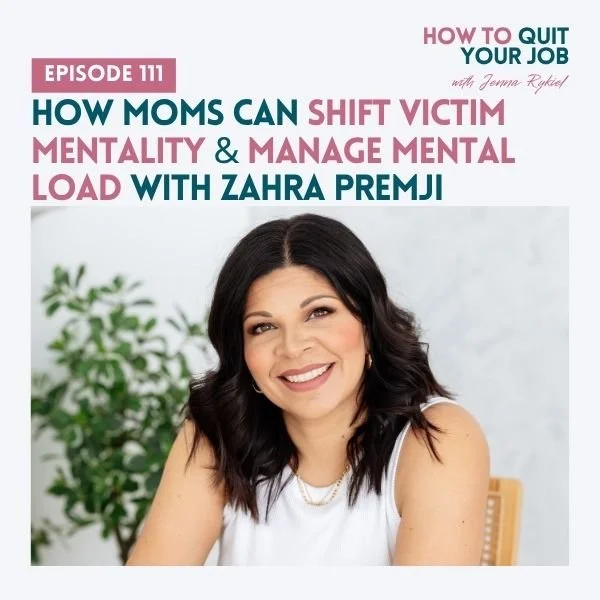
Many moms carry an invisible weight: the mental load of managing family, work, and everything in between. This constant juggling can lead to feelings of overwhelm, frustration, and even victim mentality, making it hard to feel confident or move forward in your business and life. You’re not alone; this is something almost every mom experiences at some point.
In this episode, I talk with life and mindset coach Zahra Premji about how moms can start to shift victim thinking and manage their mental load. We explore why moms often get stuck in overthinking and taking on too much responsibility at once, and how this pattern keeps you from taking aligned action. Zahra shares strategies for identifying the mental load, understanding where it comes from, and breaking the cycle so you can reclaim your energy, focus, and sense of control.
If you’ve been feeling weighed down by overwhelm or caught in the “I should be able to handle everything” mindset, this conversation will help you see a new way forward. You’ll hear practical tools to start taking meaningful steps to build the beautiful life you want for yourself and your family.
Ready for clarity and a simple action plan to get your business started? Schedule a free 1-hour consultation with me here!
What You’ll Learn from this Episode:
How mental load affects energy, focus, and decision-making for moms.
Why victim mentality can keep you stuck and how to recognize it.
Practical strategies for identifying and managing your mental load.
How small mindset shifts can create clarity and momentum.
How to reduce overwhelm without removing responsibility.
Listen to the Full Episode:
Featured on the Show:
Click here for step-by-step instructions to leave a rating and review to let me know what you think, and don’t forget to share the podcast with others who you think would benefit!
If you're looking for the right environment to start your networking journey, look no further than my group, the Mom Entrepreneur’s Circle. Sign up here for mutual support, advice sharing, and the tools you need for both you and your business to thrive.
Episodes Related to Victim Mentality & Mental Load:
Full Episode Transcript:
Zahra is a coach, a mom, and someone I deeply respect. We've trained together, gotten coached alongside one another, and had conversations about what it actually takes to create change in our lives and in the lives of our clients. And what I appreciate most about Zahra is that she doesn't just teach these concepts. She truly has lived them. In this episode, we talk about victim mentality. We talk about ownership, burnout, self-compassion, and the mental load that so many moms carry every single day.
But this isn't your run-of-the-mill conversation about the mental load. This isn't a conversation where we vent and complain and talk about delegation or talk about specific strategies to release the mental load. It's a conversation about true empowerment because while there are so many things in life that are outside of our control, there's also so much more within our control that we often do not realize.
If you've ever felt overwhelmed by everything on your plate, if you've ever found yourself thinking, why does this always happen to me or why am I carrying all of this alone? If you've ever wondered whether it's possible to feel lighter, more energized, and more in control of your life without changing everything about you, I know you're going to love this conversation. Let's dive in.
Welcome to How to Quit Your Job, the podcast for moms ready to ditch the nine-to-five and build a life and business they love. I’m your host, Jenna Rykiel. Let’s go.
Hi, Zahra. Thank you so much for being here.
Zahra: Hi, Jenna. Thanks so much for having me. I'm so excited to be here.
Jenna: This podcast has been around for over two years, and I think that I've thought about the topic of victim mentality for probably at least once a week. And I haven't done it yet. And then when we were prepping for this episode, it came up naturally, and I think it's where I want to start because you have such growth in this area. You have such expertise from both a coach perspective and from a human mom perspective, and I think that would be really powerful to bring to the audience. So, can you tell me a little bit about your story with victim mentality, how you think about victim mentality, maybe even what it is for those who've never heard that term?
Zahra: Yeah, okay. So, what I now think victim mentality is essentially giving all of your power away to situations and circumstances that are out of your control instead of really taking responsibility for what is within your control. And I say that not from a place of judgment ever because I think so many of us, it's just kind of so deeply ingrained in how we operate, and I can see this to be true for myself that sometimes when you're just right in it, it's so hard to step outside of whatever is causing you so much pain and suffering and realize that there is sometimes a part that we play in it. And again, not from judgment, but just from ownership and empowerment.
And so, I think victim mentality is just it's an inability to see where you can take responsibility for certain situations and circumstances. And it's that whole idea we hear all the time about your circle of control, and intellectually, I think we all know that we just have to focus on what's within our control and then not focus on what's not. But I think applying that, actually doing that in practice is very, very difficult when it comes to our thoughts and our emotions.
And so, that's what I really perceive as the idea of victim mentality. And I saw this playing out in my life for a very long time. And I think you had asked like just as a as a mom and as a human, how that showed up for me. And I think I really just outsourced my happiness and my joy, my time, my well-being, my energy. I was outsourcing it to everybody else. So, if, you know, I'd had a bad day with my kids, it was my kids that were responsible for my frustration or my exhaustion. If there was a challenging situation at work, it was my boss or whomever I was working with that was responsible for me feeling unsupported or feeling like I couldn't focus on my priorities.
Like I just kept seeing everything and everyone around me as the reason for why I couldn't live the life that I wanted to, why I didn't have the time for the things I wanted to, why I just wasn't feeling happy and fulfilled. Like I just was constantly looking outside of myself and seeing the part that others played in my happiness, and to me, that felt like victim mentality. I can I didn't realize it at the time, but I can look back on it now and see because I've shifted that so much and operate very differently now, I think I can see now how that was really playing out.
And I think the impact of that was that my relationships didn't feel as connected or enjoyable as I wanted them to. I felt like I was constantly on autopilot and just like going, going doing everything for everybody else, and it was just a really over time, it created a lot of misery in my life. And I think one of the biggest things that made it challenging to shift that was that I thought that's just how it is. I thought this is just how it's supposed to be.
And I had seen that play out so much in my surroundings, whether it was my own parents or within our culture and in our community. Like I just saw so many people operating that way and using language of victim mentality that I just adopted that as my own and didn't realize until very late in life that I got to question it. I was allowed to critically think about this and to see like, do I want to keep operating this way or do I want to do it differently? And that was kind of where the real pivot happened for me. So, I know you asked me a couple of questions. I don't know if I've answered all of them.
Jenna: I think it's like interviewing 101 is to not ask multiple questions at once, but you handled that really well. I notice for myself too, I mean, I struggle with this. I think we all do to some extent. It's sort of the why me mentality or this always happens or why do I have to deal with this again? A lot of that will go through my mind, and I'll now be able to catch myself and say like, wait, Jenna, you're stepping into victim mentality. You're giving away your power. You're not taking ownership over whatever is happening.
Can you talk a little bit about the benefits of taking ownership? Because I imagine some people might think there's a lot of shame involved in that or blame or we might feel sad or judge ourselves for taking ownership of these things. What is the benefit of that, would you say?
Zahra: So, I think the greatest benefit is to feel empowered in your own life. And I know that can sound a bit cliché, but I think sometimes taking responsibility of what's ours to take responsibility of doesn't feel good in the moment. It can bring up a lot of emotion because a, I don't think we like to be wrong. And when we start to take ownership and responsibility, then we have to look back at situations where we didn't, and then we make ourselves wrong for it.
And I think that can feel really painful. It's like, oh, why didn't I do this up until now or even if we do have that tendency to blame ourselves or shame ourselves or judge ourselves, that will be probably like the instinct to go there and be like, shit, like I wish I had known this earlier and why didn't I? And then almost like go into this spiral or mental beat down about that.
So, but going back to your question about what's the benefit of it is that in every situation and most of these are challenging where I think taking responsibility is a greatest benefit is like in every situation, in every conversation, in every dynamic, in every hard moment that we experience, I think feeling powerless in that is it actually layers on suffering. It makes us feel even more helpless or more resentful.
And I think when you can take ownership of it, even though it does feel like work and it does require some level of energy and expenditure of brain power, it's just every moment you're in a tough situation, you're like, oh, wait a second. Like, here's what's within my control. Here's how I can move through this. Here's how I can move forward. And while that doesn't always feel good, it's still I think in so many ways helps us continue to move forward rather than staying stuck. So, to put it simply, I think it's the difference between staying stuck in a situation and getting ourselves unstuck and being able to move forward or move through something.
So, I think when we can take responsibility of it, then we have almost like our action steps ready for us. Like we're like, oh, I know how to move through this. Even though it doesn't feel good and even though I would of course love to blame somebody else and make them responsible for it, it just feels more like I can do anything. There's nothing I can't handle. There's nothing I can't move through. And that even though I may stay stuck for a little while, I know eventually I will figure out how to get my way out of it.
Jenna: Yeah, 100%. I think, I think really what you're saying is if we take ownership, we then are saying we created this in a very empowering way, and so we can change this. We can't change our kids. We can't change our partners. We can't change our neighbors. There's so many things in life that are outside of our control, even though we try and control many of them. But if we say the answer to our happiness or getting unstuck or getting out of resentment and frustration is our responsibility, then like you said, we take different actions, and we actually create those feelings that have us feeling better.
Zahra: And I think one thing if I can add is one question that I really love to ask myself, and I also invite my clients to ask this question is, what part do I play in this dynamic continuing? And I really strongly encourage my clients to do it from a place of compassion and curiosity. So, not like, oh, why is this my fault? Like I think that's a very unhelpful question.
But if I were to really step out of this situation and just get curious about it, what part have I played in this dynamic continuing? What part do I play in this situation happening repeatedly? And if we can just kind of love on ourselves as we answer that question, it feels less painful, and then the answers become so clear.
And if I can share an example, this past weekend, we held this celebration of life for my sister-in-law, and it was a lot of work and energy, and we had a lot of people come through. And the day after, I really just needed to recover. I was exhausted. I was still feeling a lot of emotions, and I just wanted to sit on the porch and have my coffee and just breathe, just reflect, just kind of be.
And my husband was thinking about something else. He was like, oh, we need to start figuring out like our vacation plans and we need to also like there was a few tasks that he had on his mind that he wanted to talk about. So, he joined me on the porch, and he's having his coffee and he's like, oh, can we talk about this? And what about this? And I was thinking we should do this.
And I, in that moment, I said to him, honey, I know that these are things that you want to tackle, but I am not in a space to think about those things. I'm tired. I don't have the capacity, and I just don't want to think about it right now. Can we connect about this later? And it was such a, an interesting shift because I know there was a version of me five years ago or maybe even three years ago, maybe even more recently than that, that would have silently been like, oh my god, like why is he asking me to do this right now? Why is he asking me to think about this? Why does everything fall on me? Why can't I just catch a break?
And I would have probably engaged in the conversation, but from a place of resentment and disconnection and being in that victim mentality like, why like can't I just even have five minutes to breathe? And so, if I were to step back and ask myself, which I did at some point, be like, why does this continue to happen? Like what part am I playing in allowing this to continue? From a place of love and compassion, oh, I don't speak up in those situations. I continue to engage in those conversations, and I don't let him know that right now is not a good time for me to think about it.
And so, when I started doing that, of course, the first few times I did it, it felt wildly uncomfortable because I'm like, I want him to be angry or upset or think that I'm not getting things done. Like I had my own little stories about it, but I realized that if I just give myself that time and space to breathe, even if it's five minutes, then I could come back to these conversations more refreshed, more recharged. They'll be more fruitful, more productive.
And so, that's just an example to illustrate when I ask myself like, what part am I playing in this? What have I not said? What have I not done? Why does this keep continuing to happen? There may be a part that I can take ownership of, and now it's just it happens with so much ease where I just say, honey, not ready to have that conversation right now, or I can't help you tackle this right now because I'm focused on something else. And now it just comes out more easily, and there's just no drama about it. So, just to I wanted to share an example of how that shows up in my life of just taking ownership.
Jenna: Yeah, 100%. And we have gone through the same coaching certification program, and we get to be client zero, which I always love seeing the tools and seeing how coaching like manifests in our own life, the changes that we can so clearly see in these seemingly small moments, but I've been there too.
And I've probably been on the other side where I'm trying to get things done with my husband and he's like, I am so tired. Why do you always ask me things after bedtime? And I'm like, oh my gosh, like well, when do you want, you know? And it can just turn into such a big dramatic spin where there's then feeling resentful, there's frustration, there's anger, there's attitude, there's silent treatments, there's snippiness. And it all can be avoided by just being able to recognize these pieces of jumping in and out of victim mentality.
Zahra: Totally. And actually one thing as you were speaking because when you said you've been on the other side of it, I have too. And what also shifted when I started to really understand when he was asking me to talk about something I didn't want to talk about, and because I gave myself compassion and was like, you know, it's okay that I don't want to talk about this right now or it's okay that like I don't have the capacity. And if I just vocalize that, then we can figure out another time.
And I think the act of giving myself compassion in those moments and giving myself grace has also enabled me to have it for him. So, now when he says to me, babe, I can't tackle that right now like or I'm focused on like even as we were getting our home ready for this event that we were holding on Saturday, there were tasks that I was like, oh, I really need his help with this. And I was like, babe, can you come help me with this right now? He's like, no, I'm focused on like mowing the lawn or whatever. I'll do it later. And I just wouldn't get as impatient with him because I'm like, oh, I've had to be in that situation too where I've had to give myself grace and compassion.
So, it is one of those things where the more we do it for ourselves and the more we apply the tools that we've learned in coaching to ourselves, the better I think we're able to also give that grace and space to others without making it mean something awful or without taking it personally. I think that's something that I've noticed for myself and my clients too.
Jenna: Yeah, 100%. I think we could all use a little bit more self-compassion, compassion in general. I was just talking to my coach about that yesterday. I want to shift a little bit, but it's not a huge shift because I think it's along the same lines. And you and I the other day had a pretty deep dive into this, and I know that you and I share very similar countercultural beliefs about this loaded term, dare I say. I want to talk about mental load for moms. I want to talk about it and maybe introduce some mindset shifts, some ways that we can empower moms.
I know that the mental load has been something that I've, of course, experienced as a mom. I've felt seen in different spaces talking about the mental load. I've felt seen even when my husband has brought up the mental load when he's learned about it in his spaces. I want us to talk about a different way to think about it because I know that we both find it to be at this point in our careers as coaches and working with moms, we find it to be something that holds us back and maybe not in the way that people and listeners might be thinking. So, can you tell me a little bit about the mental load for you and how it has evolved for you over the years?
Zahra: What I consider to be the I guess loose definition of the mental load is it's like these never-ending open tabs that we keep in our brain of all of the things that need to be done, the who needs what, the decisions that need to be made, the anticipation of what's to come, and really, it's just like taking ownership and responsibility for all of the different facets and parts of our lives and really kind of having it be a running list that we keep in our minds. So, I like to define these things because I feel like when I define them that I know what's creating the problem for me or what's creating the suffering and then how do I move through it?
So, if that's the mental load, it's just like really thinking about like who's on first and all of the things that need to be done and all of the things I need to not forget. Like and we're keeping that in our minds, of course that's going to feel heavy. And so, that's really what I believe the mental load looked like in my own life.
And I remember the first time a girlfriend sent me this article about the mental load, and it was pre-coaching for me. It was before I knew what I knew from our coaching certification. And I was like, oh, I feel so seen like you said. I'm like, oh my god, this is exactly what's happening for me. And what it really did was just validate the way that I was already operating. So, living in constant overwhelm and feeling frazzled and feeling like a hot mess and like, oh, yes, other people are experiencing. So, it validated it for me.
But what did not happen, which I actually now realize I really needed was I needed to figure out how to get out of that pattern of carrying everything in my mind, thinking about things incessantly, going to bed thinking about them, waking up thinking about them. It was just creating often a low-level stress, but sometimes a high-level stress which showed up as anxiety for me. And it was creating just this real feeling of not having control in my life, never feeling relaxed, never feeling settled, never feeling like I could slow down. I just was like constantly thinking about all of the things in my brain.
So, you and I talked about this last week, and my stance on this is that the mental load is optional. And that's not to say that we don't have responsibilities as mothers and entrepreneurs and career women, like whatever it is that we're doing, of course, there are responsibilities that we carry in each aspect of our lives.
But choosing to keep it in your mind as a constant running list and constantly thinking about it, I think that part is optional. I think how we handle the load is optional. When we talk about our superpowers, I think as mothers and when we are carrying other responsibilities, we have this innate and sometimes learned ability to be able to manage multiple things, to pivot quickly, to be dynamic, to be adaptable, to really anticipate other people's needs. Like I think all of those are incredible skill sets that we have, but we need to not use it against ourselves.
And I think carrying everything like that in our minds as this like spiral or this running list is actually it's slowing us down. I think it's actually detrimental for us. I think it's creating so much more anxiety and overwhelm that we're not actually able to really connect to our people in the way that we want, whatever is giving us purpose in our lives in the way that we want. Like I think it's actually a distraction. I think it's holding us back. So, I have a lot of thoughts about the mental load, but as you can tell.
Jenna: When you were talking, it's so connected to the victim mentality conversation too because I read those same articles. I felt similarly validated, similarly seen, and it perpetuated the victim mentality. It was like, oh, see, we all have this mental load, and we're all victims. And like you said, it perpetuated the feelings that went with it, the resentment, the frustration, the overwhelm. And really, we're in the work of getting those feelings to change for moms because the mental load isn't going away. In the way you and I coach and what we've learned, we talk about circumstances and we talk about you can't control your circumstances. You can control your thoughts about your circumstances.
And I almost think mental load is this circumstance that we have as moms, not because we're victims, but because we're like you said, we have so many superpowers and skills, I have plenty of times coached moms about delegating and deleting things, and they just don't want to. They don't want to delegate something because they're the best person to do it. They don't want to delete something because it really means something to them. And I've gotten to a place where I'm like, yes, let's keep it all, but let's manage it differently.
And that might be some of the tools, and I know I want to ask about the tools and the actual like action steps that you would recommend. But I think it's also just thinking about the mental load differently, like thinking about it as a superpower like, wow, how amazing am I that I can handle all of these things, even in the moments where you feel like you're not handling them well, but we are. Like we are the person who is best to do these things because of all of the skills that you mentioned.
And even just shifting our perspective on the mental load, how we think about the mental load, it can actually turn from this really resentful, frustrating thing in the world of moms to something that's so empowering. And that can happen in an instant. And if you want to say anything about that, feel free, but I also would love to talk through like how do you then change? You said mental load is a choice, meaning it we don't want it to live in our heads. So, how do you coach your clients? How do you yourself take the teeth out of the mental load in your day-to-day?
Zahra: Yeah. Before I go there, I because you were talking about like our thoughts around the mental load, and you said it in the context of some of your clients, but one of the things that I love to tell myself is I am the best person to handle this. And I really I think of it because that feels much more empowering to me than why do I have to handle everything or I have to handle everything or it all falls on me. Like that's one that I hear often from my clients. It's something I used to say to myself, but it is a perspective shift that I am the best person to handle this. I am capable of handling all of this, and then the third one that I tell myself is everything is a choice.
So, if there is anything on the list that doesn't align for me, that I no longer want to do, that doesn't feel good or doesn't feel like a priority in that moment, I always have the choice to not do it. It doesn't always feel good to exercise that choice, but sometimes it's like we're just in a season right now where our family is going through a really hard loss. And so, it's not business as usual for me. I don't have the same level of capacity. I do have other priorities.
So, for me, dinner, what I make for dinner, whether or not I make dinner, like I see that as a choice that I don't have to continue to operate the way I always do with what I do for my dinner prep in a season where things are challenging. I'm like, oh, that might just look differently or I might just drop that and order takeout or make eggs for dinner or something, right? Like it's just understanding that we have choice in how we manage the different responsibilities and the tasks.
To your question about how I handle the mental load because I actually feel like given like my kids are older. I have a 20-year-old and then I have a teenager who's going off to university, and then I have a daughter who does competitive dance. When I think about the volume of tasks and responsibilities, it feels far greater now than it used to even like five years ago. And my husband travels for work and I have aging parents and things like that.
So, one thing that I really feel strongly about when it comes to the mental load is I don't want to keep it in my brain because I believe that our brains are not meant to store information. They are meant to process, to plan, to execute. Like I want to use my brain's capacity to be able to solve problems and to figure out like how to plan and execute and take action. And I think if I'm just focused so much on storage, like trying to like keep everything and remember everything and not forget anything, I feel like I'm not optimizing the way that my brain is functioning.
So, for me, what feels really important is to get it all out of my head and onto paper. And it's really just like as simple as sometimes I just grab a fresh sheet in my notebook. I get a pen, and then I'm just like for 10 minutes, I'm just going to get everything out of my brain and onto paper. I do find that some of my clients have some resistance to this because they believe that if I see it on paper, it's going to be more overwhelming for me, but once I actually get them doing this and in my own experience, I actually feel some relief.
Yes, I will look at a page and like, wow, there's a lot to do, but it almost feels better because I see it there in front of me rather than like things moving like a ticker in my brain. That feels more overwhelming. So, I think that's one of the most important things we can do for ourselves is what are all of the decisions I need to make? What are all of the tasks that need to be done? What's even if I'm thinking forward planning like what needs to get done a week from now, a month from now, maybe it's our summer camp registrations, it's for me it's my daughter's dance registration, it's helping my son like get his accounts set up for university.
So, I find getting it out of my brain, sometimes I use a notebook or sometimes I'll just do it in my notes app on my iPhone, depending on where I am and what I have access to. Really, the priority is get it out of your head and onto something that you can just see visually what are the things that are cycling in your brain that you need to do. So, I think that's a really important step. I don't know how what your thoughts are about that, but yeah I’d love to know.
Jenna: No, no, no. I 100%, I do that with clients as well. I think it's important. And yeah, similarly have had resistance. I've actually had more often though, the person who's resistant, they don't want to put it on paper because it's going to be too much. They put it on paper, and we collectively are like, oh, that's not really that much. That happens so often where I'm like, we're just working through the list.
I think of it as like the devil you know. When it's on paper, it's the devil you know and you can handle it. When it's in your head, it is the devil you don't know. It is just swimming. You don't actually know how many things you have. And so, we like to put it on paper for the devil you know. But it's so funny how we do, we build it up in our heads. Not to say, like some people, of course, they have multiple pages full, and we can tackle that as well. We can figure out a plan for it. But more often than not, the people write down everything, and then we're like, I guess that's it. I guess that's not that much. And it, I love it.
The other thing I will say, going back to your analogy because I thought it was so brilliant, is the tabs open in our brain. I love it. I have one client I adore. I'm sure I have many more, but one client specifically who talks about all the tabs that she has open and like, she even jokes about it and says it's a problem, like I have all these tabs and sometimes when she shares her screen in sessions, I see all the tabs. And it's one of those things that we don't realize how much energy it takes to have all those tabs open.
But we can do a quick test of like how good it feels to go through all the tabs and close them out, right? Sometimes I even just click the red X, and I'm like, you know what? What didn't get done and what is meant to get done will come back up in my world. But imagine going through each of the tabs, whatever tabs you have open like the, you know, you wanted to buy something and you had to fill out the registration and you wanted to do this and you had this open for this.
If you thought about actually going through and finishing everything that you wanted to do on those tabs, reading that article, whatever it is, and they all closed out, the amount of relief you would feel. And that's happening, I mean granted, I would argue probably we don't need to do all the things on all the tabs that we have open, but it's that sort of relief just being able to close out the tabs and work through them in a way that feels strategic versus just having them open on your desktop all day, every day.
Zahra: Which I think is made so much easier, like the act of closing the tabs is so much easier when you do that first step of getting it all laid out for yourself. It's like, oh, this is what I have to do. It isn't as big as I thought it was. And now let me just go start tackling the things. And I just think it's made so much easier when we are not expending the energy as you said in trying to remember it all.
I think that was one of the things that was actually consuming so much more energy for me and creating so much more stress is like, what if I forget? Or I would go to bed and I would be like, I have to remember to do this thing tomorrow. The anxiety and the stress was around forgetting to do the thing versus if I just put it on paper somewhere, I don't have to expend that energy or have the heavy lift of trying to remember the thing. It's just, okay, the thing is on paper, and I know I will deal with it.
And I know you and I talked a little bit last week and we may get to this as like actually scheduling it in to your calendar, which is just taking it that extra step, which is like, oh, like I don't even have to I know I have it on paper. I don't even have to worry about when I'm going to do it. I now have it in my calendar. So, I know exactly when I'm going to do it. And I just think that the amount of relief that I would have in knowing that the things that I need to get done, I have a placeholder for them would give me so much more relief and peace.
Jenna: 100%. Yeah. I always have people take that next step and really whether it takes one hour, two hours, three hours, you work through the list and you maybe there's things you delegate, maybe there's things you delete. But everything gets put and scheduled when you're actually going to do it. And you do feel the sense of like, okay, if it's on the calendar, if I've set aside time, it's as good as done. I just had a client this week who in our session was in tears. Her business is doing so well, and she now is really stressed out about being able to deliver for all of these clients.
She does interior design. And she's like, I don't know how I'm going to have the time. I feel so lost. And so, what I said to her was, we need to write down everything for these 13 clients and when they need the certain things by, it's going to be overwhelming, and we're going to write every single thing down, and then we're just going to plug it in and figure out when we do what.
But the reason that she was so upset and exhausted and to tears was because she was so lost as it pertains to her time. Everything was living in her head, and it was so overwhelming. She's setting aside one full day, one full work day to actually map out and put it in her calendar exactly when these deadlines need to be. And even just talking about it, her energy completely shifted. She was like, yes, like now I feel relief. I have a plan. I'm going to figure out how to do this. But again, when it's in our heads, it's the devil we don't know because we don't see it.
Zahra: And what you just described about that process of getting it all out and mapping it out is going to reduce her overwhelm so much that she will not be stuck in freeze mode. Like she's actually then able to move into, okay, let me plan, let me take action, let me get this thing done, let me get that thing done. When we are in overwhelm and we are in that state of freeze, which is often the case, like that's the nervous system response I tend to see most often with my clients when they're experiencing overwhelm, our brain, the logical, wise, you know, our prefrontal cortex stops functioning. Like we can't access that.
And that's the part that's responsible for our planning and our executive function and our problem solving and our wisdom and our logic. We literally don't get access to that when we stay in an overwhelmed state. And that's one thing that I explain to my clients is we need to get you out of that state so that you can really access the part of your brain that's going to help you move through this rather than feeling stuck and frozen, which builds and builds.
Like it's a really vicious cycle if we stay there, and it's what I often see as the precursor to burnout for so many of my clients is just operating in that state of overwhelm and anxiousness and high stress for a prolonged period of time. I'm like, we want to avoid the burnout or recover from the burnout, we need to be able to get you out of overwhelm. And I think that's one of the most powerful ways to do it. Is to just get everything out and planned and scheduled and then just focus on taking action.
Jenna: Yeah. It really does minimize mental drama and spinning in indecision when you just have this list. You decide when you're going to do it, and then you just execute. I do want to talk a little bit, so how do you support your clients as a coach? Talk a little bit about what you do, and then a little bit about how you got there.
Zahra: What I believe I do with my clients is I help them live a life that feels as good as it looks. And so, a lot of the women that I work with have achieved incredible success in their careers. They have beautiful families. They have the things that when we were younger, we would have probably had this checklist of things that we want.
What I've noticed so often is the women that I am connecting with are feeling maybe some level of emptiness, maybe unfulfilled, feeling so much resentment, feeling, you know, a little lost in their lives or maybe stuck. And so, my hope is to really help women have more of a match between what their life looks like but also how it feels on the inside. So, having, you know, more meaningful and connected relationships and feeling like they are taking action.
A lot of the women I work with are really good at following through on the commitments they have to other people, but one common theme that I see so often is that they're not really great at following through on the promises they make to themselves. So, it's like the workouts that keep getting pushed or they have this dream or this business idea that keeps getting pushed or a vacation or a day with friends that they want to plan. Like it's just all of these other things that they maybe don't see as being as essential or high priority, but they keep getting pushed off. And then I think as a result, our, we erode our self-trust, right, over time if we continue to keep putting our own needs on the back burner, we stop trusting in ourselves to be able to follow through on those things.
So, I really just help them figure out what it is they want. Like we go and identify like, what do I actually want my life to look like? And we design it, and then we create it, and then I help them take action to go and live it. And I think that the way that we do this, the most important prerequisite is first learning how to have more kindness and compassion for themselves. I think so many of the women that I work with believe that the way to get ahead is by constantly beating themselves up and putting pressure and criticizing themselves.
So, that takes some time to just evolve and help them see like how they can speak to themselves more kindly and think better things about themselves. And it's really fascinating to see that once we create that shift, so many other things fall into place so easily and so quickly. It's like the greatest barrier, I think, to being able to live the life that we want is how we think about ourselves, how we treat ourselves, how we speak to ourselves.
So, I work with women usually for a minimum of 12 weeks, and in the span of that 12 weeks, because we are connecting every week together, and we are just giving an hour of time and space to solely focus on what it is that they want, whatever is coming up in their lives, we're troubleshooting, we're problem-solving, I'm giving them action steps and they're able to move forward with a very different way of thinking and feeling, the momentum actually has been really cool to watch, like how quickly things start to shift just simply from slowing down and giving them that space.
We start by setting a goal of, you know, sometimes it's a tangible thing that they want to be able to do, but sometimes it's intangible like, I just want to feel better or I just want to wake up without feeling this panic or dread. And we just figure out how to really make that specific so that they know what they're looking for and how to measure progress. And then I'm just really supporting them with every step along the way. I check in with them. I will always come back to what they said they wanted.
So, you know, I think as women it's very easy to as life gets busy, we're like, oh, I got to focus on this thing and I got to wait till things settle down and I'm like, no, but this is one of the things you said you wanted, how do we still continue to make that a priority even amidst the busy season that you're in? So, that's really how I work with my clients. It is very personalized and customized to what they want in their lives, and I help them figure that out. And your other question was how did I get here, I think you had asked. How did I get to this place?
All of the things that we talked about earlier in the call, living really in a state of overwhelm, constantly on autopilot, really just trying to manage the mental load, feeling a lot of resentment, a lot of self-pity, like that was really how I operated for decades, like for at least a couple of decades after I had kids. And it eventually caught up to me. I think I had been repeating cycles of burnout, crash, recover all my life. But it hit me really hard in 2022 where that year we had so many challenges to overcome.
My mother-in-law was sick, my sister-in-law was diagnosed with cancer, we went through a massive home renovation, my kids were going through stuff at school with friends. It was like the storm of all of these big challenges that happened together in one year, and it was after COVID. We were figuring out what it looked like to return to work. That was creating a lot of stress, and eventually I got to a point in the fall where I felt like I just could no longer function. I was so anxious and so depressed and so stressed all the time that I was like, I just really need to take some time off work.
And that was really the first time, and it, even when I started my leave, part of me was like, oh, this is a good opportunity to get projects taken care of at home. Let me go tackle the basement. Let me go declutter their garage. And it's so interesting to look back and see that's where my mind went was like, let me go use this time to get more things done. But eventually I had to really succumb to the fact that my body was like, no, we're not doing this right now. It's time to rest. And it was where I just started to get really honest with myself about how the way I had been operating was just no longer working for me anymore.
And I started thinking about the trajectory of my life if I kept operating that way. Like what would this look like in another year, two years, five years, 10 years? What are my relationships going to look like? What is my health going to look like? What is my just overall feeling about my life going to look like if I keep operating this way? And it was a hard conversation to have with myself, but it was a necessary one, and it was the one I realized like, I've got to change how I'm doing things.
So, to put a long story short, I really recognized I had to work on overcoming my people-pleasing, my perfectionism, my autopilot mode that I was so often in. And it's what led me to want to do my coaching certification. I was like, I had some exposure to another life coach, and I just really thought, oh, this is interesting to realize that my thoughts are what are creating my emotions and what's essentially creating my experience of my life.
And I wanted to delve deeper into that and learn it more for myself, and then when I started learning it, I was like, oh, women need this. Like women need to know this. What they need to, I wish this was taught in school as mandatory curriculum because it was really life-changing for me. And I just decided that was what I wanted to do as a career is to help women make their lives feel better and in whatever way that looks for them. And so, that's what brought me here.
Jenna: I love it. There's so many different stories about how moms and women get to a place where they start their own business, and you are definitely not alone in the rock bottom of burnout and then sort of like kind of building from that place of recovery and healing and like bringing it all together and really figuring it out. But unfortunately, from that space of just breaking down and experiencing burnout, which of course, both of us support women to not get to that point, but so many women are already there.
Well, I'm so glad you're here. I'm so glad you're coaching. I've loved chatting with you. I've loved being a part of each other's journey in group coaching and in the spaces that we're in together. It's been truly inspirational. We will, for anybody who wants to connect with Zahra, we will have her contact information, socials, all the things in the show notes.
And I would love for people to get to know you a little bit more to work with you. Maybe we'll have you back on the podcast for deeper dives into some of these things because I know that this will be new for a lot of people and sometimes provide some relief, but also people might want more to learn more about some of these things that we've talked about because they're really big in mom's lives.
Zahra: Yes. Can I share one more thing just that's just on my heart as I'm hearing you speak? For anyone listening, I think one of the things that really stops us from being able to create the lives that we want is believing that this is just how it is. And I think sometimes one of the things I commonly hear from women is, well, this is just how I am, or they've seen so many examples surrounding them of women that are also operating that way.
So, it does become really challenging to believe that you can do it differently. And I really kind of made this pivot in my life at the age of about 47, I think. And I'm now going to be 51 this year. And as soon as you decide you want more from your life and you start to get the support to create it, the changes start to happen quickly. But then there's like these ripples that where you start to have these moments where you're like, wow, like I'm living my life so differently in such a short amount of time.
So, I also really want to say that once you make the decision that you want to do things differently, it's not like you need another three or four decades to create that change. When you start to see your patterns and how you've gotten to this place and you just have awareness and you know what to do, you can actually create shifts very quickly.
And so, I just want people to know it doesn't take another lifetime to like start living the life you want. It can happen sooner than you think, but it really just comes with making a decision, telling yourself, I'm ready, I want something different for my life. I deserve something different for my life. It doesn't matter that most of the examples around me might be living differently. I get to have the life that I want and that it can happen sooner than people realize. So, I just really that felt on my heart to say. So, thanks for letting me share that.
Jenna: Yeah, well, I'm so glad you said that because I just recorded an episode, episode 110, that was exactly that. You know, we're about halfway through the year, and if the change that you wanted to create hasn't happened, it doesn't mean that this still isn't the year for that to happen. Because episode 110, that's what it's all about. Change happens in an instant. Of course, starting a business and, you know, leaving your job, like those bigger transitions take some time.
But feeling better can happen in an instant. And yeah, like you said, the changes, it's a domino effect of what can happen after you make that one decision of like, okay, I'm committed to myself. I'm committed to doing things differently, getting support, showing up differently, feeling differently. I love that that was on your heart to share because that has been on my heart recently too, that people delay because they think it's going to be so much work and take so long. It is work, but it doesn't take long to see results and to feel better.
Zahra: Yeah, and it can happen alongside your other priorities. Like just when you said like, you know, people think like, I can't take the time to do this, but so often, I'm sure many of your clients and mine as well are doing this work alongside still managing their priorities. They don't have to abandon their jobs or abandon their businesses or their kids or their families. It's like, oh, no, actually I show up better when I'm doing this work and making my life feel better for me. So…
Jenna: Yeah, 100%. I know. I always will have conversations, and there will be reasons why this isn't a good time to do this work. People will say, you know, summer's starting or school's starting or I have a lot going on, and I'm like, oh, if you have a lot going on, that's the best time to do this work.
Zahra: Yes. 100%. Yep, absolutely.
Jenna: So yes. We are aligned on so much. Thank you so much, Zahra. Again, I'll put in the show notes all the ways to get in touch. And we will see each other again soon.
Zahra: Yeah, thank you so much for having me. This has been such a great conversation. I loved all of it. So, thank you.
Thanks for listening to this week’s episode of How to Quit Your Job: A Mom’s Guide to Creating a Life and Business You Love. If you want to learn more about how I can help you stop making excuses and start making moves, head on over to www.jenna.coach. I’ll see you next week.
Enjoy the Show?
Don’t miss an episode, follow the podcast on Spotify, Apple Podcasts, or RSS.