108. Leaving Your Job Intentionally Without Sacrificing Security with Tania Brown
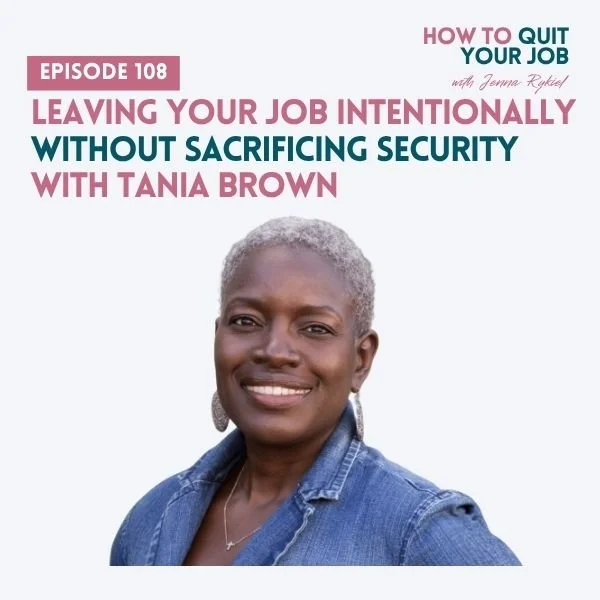
Many moms achieve great success in their careers, building financial security and climbing the corporate ladder, yet still feel unfulfilled or wonder if there’s something more. You might have thought about starting a business or working for yourself, but feel uncertain, worried about family responsibilities, or unsure how to make a safe and secure transition.
In this episode, I talk with CFP and job exit strategist Tania Brown about leaving your job intentionally without sacrificing your family’s security. We explore common fears, all-or-nothing thinking, and practical strategies to help you determine whether you’re ready for a change. You’ll hear how deliberate planning can help you make a career shift safely and confidently.
If you’ve been considering leaving your job but aren’t sure how to do it responsibly, this conversation will leave you with mindset shifts and planning strategies that make it possible. You’ll learn how to approach a career transition thoughtfully, protect your family’s security, and create a path that supports both your professional goals and personal priorities.
Ready for clarity and a simple action plan to get your business started? Schedule a free 1-hour consultation with me here!
What You’ll Learn from this Episode:
Why intentional planning is essential when leaving a job as a mom.
How to overcome fear and all-or-nothing thinking during career transitions.
Practical steps to create a safe and structured exit strategy.
How to balance financial security, family needs, and career aspirations.
How thoughtful planning builds confidence and clarity.
Listen to the Full Episode:
Featured on the Show:
Click here for step-by-step instructions to leave a rating and review to let me know what you think, and don’t forget to share the podcast with others who you think would benefit!
If you're looking for the right environment to start your networking journey, look no further than my group, the Mom Entrepreneur’s Circle. Sign up here for mutual support, advice sharing, and the tools you need for both you and your business to thrive.
Episodes Related to Leaving Your Job Intentionally:
91. Building a Business Without Quitting Your Job (For Moms Who Want Financial Security)
94. From Maxed Out to in Control: A Working Mom’s Transformation
96. How Starting a Business as a Mom Can Give Your Family More, Not Less
Full Episode Transcript:
Jenna: Welcome to How to Quit Your Job, the podcast for moms ready to ditch the nine-to-five and build a life and business they love. I’m your host, Jenna Rykiel. Let’s go.
Hi mom friends. Today's conversation is for the mom who has built a successful career, worked incredibly hard to get where she is, and yet still finds herself wondering, is this it? It's for the mom who has spent years climbing the ladder, building financial security, proving herself, creating success, but who also knows something isn't quite fitting anymore.
Maybe you've thought about starting a business. Maybe you've wondered what it looks like to work for yourself. Maybe you've been catching yourself daydreaming and wishing that you could just leave your job. But then reality kicks in. We think, what about the paycheck? What about the benefits? What about the family depending on me? What if I make the wrong move?
Today's guest, Tania Brown, helps women navigate exactly those questions. Tania is a CFP, a job exit strategist, and founder of The Confident Quitters Collective. And she specializes in helping women create a financial roadmap to leave corporate and build something of their own without blowing up everything they've worked so hard to build. Yes, her and I get along really well.
And what I love about this conversation is that neither of us believes you have to burn everything down to create change. In this episode, we talk about what it really looks like to leave a corporate career intentionally, why so many women think in all or nothing terms when it comes to career decisions. We talk about how to know if you're actually ready for a change, and the surprising truth about courage, fear, and regret. Of course, we also get into motherhood, identity, financial planning, and some really practical ways to think about creating a life and career that actually align with what matters most to you.
Tania is a mom of nine. So we talk about some really fun mom stuff. I love her story. I know you will too. Whether you're actively thinking about leaving your job or you're simply wondering if there's something more out there for you, I know that you're going to get a ton out of this conversation. Let's dive in.
Hi, Tania. Thank you so much for being on the podcast, for being here with me today. I am so excited to talk to you.
Tania: Thank you for having me. It's my pleasure.
Jenna: Yeah. I would love for you to actually give a little bit, maybe just the summarized version of what you do because I feel like we are very aligned in how we support women and moms, but we do it in slightly different ways and I love the alignment. So do you mind just even giving a quick overview of what you do?
Tania: Yeah, glad to. So I often say that my job is to help people quit theirs. So specifically, I help employees navigate, in some cases, the financial complexities of making that transition from corporate to being self-employed. And I often say if you scratch the surface of what I do, what it really is that I help empower women to let go of what no longer serves them so they can grab a hold of this new dream that serves the life they want.
Jenna: I love that. Yeah, I feel like that is what it's all about, right? Creating the change in our life that helps us to find more joy, find more meaning. And sometimes it gets to a point where corporate is no longer it. The other thing that I think is fun about what we align on is that we both help and talk about helping women and moms quit their job, but we also talk about doing it in a very intentional way. So not burning everything down, but really having a plan to do it that feels like it makes the process less risky. Can you talk a little bit about how you uniquely do that with the women you serve?
Tania: Sure. The first thing is, I give them permission to not want to burn their entire financial life down because I feel like that is over romanticized and I feel like that is for someone that is like my children's ages, which are like in their early 20s. They have nothing to lose. So couch surfing and just burning everything down, there's not much to burn. But when you've worked for a level of financial security, when you have a family that is depending on you, if someone needs to hear it, you have 100% permission to take your time and to create this in a way that's unique to you.
So I often tell my clients, what does it take for you to confidently press that button in a way you won't regret? And that can look as, I mean, really, it's to the extent of your imagination. That may be staying at your job and having the business. That may be what I call looking for a bridge job, and I have a specific formula I work people through.
And that is the job that gives you the headspace, the income so you have a little bit of stability to leave. If someone's in a toxic job, there's no staying. So that's sometimes a great option if the job is toxic or if they have other obligations like putting a kid through college. It could be part-time fractional work or it could be a leap when it's right for them. But your journey should be unique to what works for you, not what sounds good on Instagram.
Jenna: Yeah, not what sounds good on Instagram, and I always say that when our emotions are high, our intelligence is low, meaning that if we are feeling so stressed out and so overwhelmed and so heightened in our job, you know, maybe something has happened recently that really ticked us off and then we just want to leave, we just want to burn it down. I find that our emotions are really high in that moment and our decision-making process and our thought process is low. We might burn bridges, we might say things that maybe we regret later on. And every relationship we have, even those relationships that we don't love in our work environments can be valuable for us in the long run.
I know that I did a training just recently that was how to quit your job without financial risk, because I find that so many moms I talk to think that the only answer is leaving their job right now because it's not working for them right now. And it's so interesting to provide some of this in-between, right? Like the in-between of waiting for equity to vest and then having more of a safety net, the in-between of having the in-between job, like you mentioned, maybe it's a different role or a different company, but it's something that helps you financially so that you can still pay the bills, you can still support your family.
I find that when I do have that training or when that I have that webinar, I see people's faces light up, like so much relief. They're like exactly what you experience, I'm sure with your clients of, oh wait, I can build this thing and still work at my job. Let's talk more about that. Let's, I want to know more. The permission giving is so valuable and important.
I also know that you have a ton of experience in the financial world, in the financial realm, in the accounting realm. Are there specific strategies or things to think about from a logistical standpoint with accounting and taxes, finances, anything like that you think would be helpful?
Tania: Absolutely. I would say the first part, if you're a mom, is timing. The decisions I made when my children were infants is not the decision I made when they were six. It's not the decision I made when they were 12 and it's not the decision I made when they were 18. Leaving becomes not only a timing for you, but it becomes when is a good time for your family. There's never a perfect time. But leaving when your kid is two weeks old, well, your body is still healing. Leaving when your kid is 18, if you're paying for college, that may need a revisit. So giving yourself permission to understand it's not only the timing for you, it's the timing for your family. That is an important consideration.
In terms of personal finances, a lot of times people have a lot of ideas as to what money they want to use for their business, and I tell them practically all money has some type of tax consequence attached. Sometimes people may want to use retirement accounts. I am a big believer in protecting your future. So that is something that would be a consideration for it to be earmarked for your future because taking it out, there are some pretty big tax hits to doing that.
As you mentioned before, if you're about to get a bonus, timing the waiting of that, if you do have equity compensation, just calling in and asking, hey, if I leave at X time, what happens? Do I lose money? What are the tax implications? Because a lot of people forget, depending on the makeup of your compensation, if you leave at a certain time, you may accidentally pull a trigger that may make what ordinarily would be paying a little bit of taxes, a lot of taxes.
So if you remember anything, just call to wherever is holding your assets and just ask, hey, what's the tax implications if I leave now? Is this the most tax optimized time to actually leave? So that's a consideration and that can make a huge difference that a lot of people do not consider.
For my group, sometimes their exits are not by choice, their exits are because they got let go from a job. And I remind them some of what you get when you leave a job has certain different taxes to it. So I say talk to a professional that's well versed in it so you don't go into sticker shock come April 15th because sometimes if you're getting a whole bunch of stuff at once and you start working another job, even if it's a bridge job, that can lend to a whole bunch of taxes. So as a nice rule of thumb, if your life is about to make a transition, there's normally a tax part to it. Just find out what that looks like before you move forward.
Jenna: Yeah, no, I love that. I was just talking to someone yesterday who was thinking about shifting things in her business. And more often than not, I'm like, talk to your accountant. Talk to somebody because there, there are tax implications and not to create fear or to scare anyone into not doing the thing that would most serve them, but just to do it in a way that's smart, to do it in a way that has some answers and some certainty. So much of what we do when we start a new business or we change our career, there's a lot of uncertainty. And I find that there's people out there who can answer these questions with pretty good certainty if they have enough of our information.
Tania: If you just remember a few rules of thumb. So if you are making a change to your business, it often times has a rippling effect. So just simply asking the questions, if I make this change to my business to a professional, is there a tax or financial consequence I am unaware of?
And that's an easy way to begin to get answers and even to be aware of, oh, is there a consequence? Sometimes it's enough, but it's having enough of a picture so you're making informed decisions because if you don't understand the implications, you're making a decision in the blind that can have a ripple effect in a way you do not want it to have.
Jenna: Absolutely. I will say though, anyone listening who has like, they're thinking like, oh my gosh, I already burnt it down and I burned bridges and I didn't ask my accountant about things. I find that anything can be repaired. There's the ripple effect and there's the ability to patch it up. You can even patch up relationships with a good repair, right? So the finances, the accounts, there are also next steps where you can repair some of these things.
Tania: Yeah, everything is recoverable. Would you mind if I share a short story because this really…
Jenna: Absolutely.
Tania: So fairly recently, I was listening to a group of 90-year-olds talk about the things they did in their life great, the things they did in their life poorly. Here's the thing that struck me. Not one of them talked about something that they tried and failed at. In fact, if they mentioned it, it was briefly in passing, but they all talked about the things they regretted. Everything is recoverable. I am not here to say the recovery is not going to be a little bit painful. I'm not going to say the recovery is not going to take time, but you can and will financially recover. What I find people don't recover from are the things they never take a chance on.
Jenna: Yeah, absolutely. And that actually leads me to, because your story is inspiring, and I want to wrap in a little bit of a question because you generally work with women who are at the peak of their career. They have built something for many, many years, and it is part of their identity. It is part of who they are. They are maybe the breadwinners. They are at the tables that they worked so hard to get a voice at.
And I know that you did that same thing, and then you had the courage to leave and the courage to say this isn't working for me anymore, and I'm going to start my own business. And, you know, I know we talked about it before, it was very much taboo in your family to do that as well. What gave you the courage to make that decision? Any pieces of that decision that would be helpful for my moms to hear?
And also maybe how you support people in making that decision. What do you see from your clients as they're making that decision? How do you empower them to change so much about their life and identity in kind of one decision?
Tania: This might sound a little counterintuitive. I did not have courage. I was willing to work through fear and I think that's a very distinct difference. Just keeping it real. I was in the fetal position crying for months. If you saw me, I looked like the epitome of terrified. But I would rather be terrified than regret. Like I fear regret more than failure. So when I realized that I am just, like it’s so funny, one of my mantras is throw up and do it anyway.
So it was working through the fear that I found the courage on the other side. It is always going to be terrifying. When you take a step back and think about it, so I'm in my mid-50s, but for some that are younger, we spend our entire life from the time we remember in this corporate infrastructure. School systems, when you think about it, are designed around corporate. The timeframes you go to school, being told what to do, your validation wrapped up in a report card, all that does is shift from report card to a performance review.
And when I finally honored myself enough to say walking away from that isn't easy, that you're walking away from how you've been indoctrinated to think, how you've been indoctrinated to be validated. And for the first time, metaphorically, you're picking up the pen and defining it from yourself. So you're going to feel lost, you're going to feel afraid. That is okay.
And I find when I tell that to my clients, I can almost see this relief because I think, I don't know if anyone was like me, I almost felt like a failure because I wasn't one of those people that just hopped into entrepreneurship. In fact, I thought I missed the memo because I did not have the courage memo. I did not have the happy memo. I had the crying, wondering did I just blow up my life memo. And I wish somebody would have said, that is okay and this too shall pass.
And you can do this in a way that's true to you. You don't have to speed your way through this. And it's almost like as the business grows, as you move on your journey, you kind of grow into this person. You kind of mature into the business owner really as you go from zero to having a business and to honor that maturity. And there are days when you're frightened, that is okay. I'm a big believer in just finding community that's transparent enough to be honest.
Jenna: Yeah, no, that's so true. It's so normal those feelings. That's why community like you said is so helpful or mentorship in it or having a coach through the process where they're like, yeah, that means you're doing something really important. I tell people all the time, my clients, if you're not feeling sick to your stomach, you're probably not doing it right. Right?
Tania: I feel like I could add to that. I think if you're a mom, have somebody that's a mom, because as much as someone who understands when the kids are sick and nothing works according to your schedule, someone who understands the mom guilt when your business is going great and you feel like an utter failure as a mother because you missed this one thing with your kids and you're like, how did you not know they were hurting or how did you not know they were struggling? And to understand that is very normal. And I think sometimes being around other moms, we get it.
Jenna: Yeah, 100%. I've loved supporting moms specifically because the, when we come together, I mean with all of my one-on-one clients every week, most of the time, those conversations are about mom guilt. Those conversations are about the guilt of taking kids from three days or two days a week in daycare to five days because their business is growing and they want more time in their business.
And what does that mean about them as a mom who started their business because they wanted to spend more time with their kids, right? And it's so interesting being able to have those conversations and really everybody being able to chime in because everybody has experienced some version of the same type of guilt or the same situation. So absolutely 100%.
Speaking of that, I want you to share a little bit of your journey as a mom, a mom of nine who has built this business and what that has been like and a little bit about how you came to be a mom of nine.
Tania: Yeah. Chaos. But they're almost all adults. So on the opposite side. So ironically, I was told very early on I would have problems having kids. So from my early 20s, I knew I wanted to adopt, I knew I wanted to foster. When I met my husband, he had my beautiful bonus daughter, and I was thrilled because I thought, okay, at least he has a biological kid. I can't give him one.
Nature apparently had a sense of humor because the very first time we tried, I popped out kids. So that was not an issue. Much to my shock. But the desire to want to give a home to children who didn't have one was still there. So we had long-term foster kids, adoption kids, bonus kids, biological kids. You throw it all together and there were nine and they were girls.
And I often get how. And I don't know if it makes sense. I think accepting chaos as a normal way of life is freeing because I didn't have control. And especially because I mothered in so many different ways, these weren't all my biological children, which meant I was dealing with foster care systems, I was dealing with social workers, their biological parents, their biological extended families.
So I think accepting that I was going to have to find normalcy in the chaos. I think if I expected everything to go according to plan, I would have driven myself nuts. I think giving myself permission to say every day, I'm going to do the best I can with the schedule in front of me because for me especially, it could shift with one unexpected court case or it can shift, you know, with most moms with the kid being sick. But permission for flexibility from myself was a really big thing.
Obviously, I became incredibly efficient at getting stuff done when they were all in school. So I was just really good at time blocking. I was really good at scheduling things within the times where I had the best shot of not being called away to do something. Accepting that at times things were going to fall apart. You know, accepting that at times, I may miss out on something and especially with that many kids, it was divide and conquer. I was going to miss something and but making sure I was there for the important things.
And here's the crazy part. When I ask my daughter, I felt like I'd missed out on so much stuff and she's the baby is now 17. She was like, God, I'm so tired of you guys. You were there for everything and I was like, how? Like they don't remember. Like it's she remembers the majority of the time I was around. She remembers that I was present. So that one thing that I guilt myself for for not being present, she does not even remember.
Jenna: Yeah. Well, that's such a good reminder of, because I imagine that part of your motherhood journey was at corporate in very high leadership positions. And then part of your journey was in entrepreneurship. And maybe even just having a sigh of relief for anyone, like you can be present and your kids can see you as present and see you as always there, no matter what track you're on. You don't have to jump into entrepreneurship to necessarily be present with your kids or to be there for them. Like you can achieve that no matter which track you're on.
I'm biased. I think entrepreneurship is the more fun way to do it and the more exciting way to build a career and then also to be able to be the mom that I want to be. I think it's good to know that it's not the only option. And I think that that is probably how a lot of people feel is that there's this all or nothing. I have to leave my job to be the mom I want to be or I stay and I have sacrifices. And when we're in that mind space, it's really hard to enjoy life and find joy and ultimately be present when we're tackling these big decisions.
Tania: It was also creating boundaries around the big stuff. One, when if your kids are like in the middle of elementary school and above, simply ask. I asked my children, what is important for you, for me to be present for? Like what are those events? You die hard, you want mama there. Those were the die hard. I put them in my calendar. I didn't care what my schedule was. I was there for, I made it clear and those are fine. For some stuff, some stuff surprised me. They didn't care, so I didn't show up. So I didn't have to be there for everything. That was one.
The other thing is setting boundaries at work, which I know can be frightening at times, especially if you're the only female. Sometimes I did get pushback, but I was just, this is my schedule, this is my time. I am not available because I have a more important appointment. It's not really their business what that appointment is, but it's my kid. And I found other people said it. So that's what I said. I didn't feel like I had to state that this was because I was going to be the guest reader at my kids' school. It's an appointment for someone that's incredibly important to me.
I treated my kids the way I would treat my valuable clients. And I think that made a difference in my perspective in how I scheduled my time and the things I did. I will say the gift of being in leadership is that I was able to help the women coming up after me. So I was able to redirect our maternity leave policy so it was more expanded. For one woman, like we were able to change it so women can have staggered time coming back to work instead of being coming back full time.
So I would also say for those of us in leadership, if we are the only ones at the table and like in most cases, we're the only estrogen who's had a kid being an advocate for other women and letting them know, like for instance I was talking, I was the only female and a woman was coming back and we were expecting her to do this and this and this. And I told them and I also don't have a great filter. I said, between what? Between the time she's nursing her kid? I said she is in a completely different body. She does not have the mindset she had before and we need to give her time to grow into what being a mother in corporate is. So being that advocate also.
Jenna: Yeah, that's such a good point too. And I think that's also another one of those pieces where it's like, if we are lacking meaning and we are lacking feeling of purpose in our corporate career, there are ways that we can tap into advocacy, that we can tap into being a changemaker, while we build the business on the side, sure.
But there's ways that we can make work feel more meaningful and impactful just by thinking about it a little differently and taking some of these or, yeah, taking some of these gaps that are in our companies, in our policies and being able to be a voice. I love that.
What would you say to the mom who is again, she has built her entire career in corporate, she's so successful, and feels like it's so hard to give up that career that she's built, but who knows that it's not working for her anymore and that she needs to make a change, but she's just feeling like she might not be able to do it. Like she's feeling like she doesn't know where to start, what to do, maybe doesn't have that courage or that same mentality around fear and regret.
Tania: I would tell her to take a step back and evaluate what exactly does success mean for her. Is success everybody thinks she's great, but she may be absent in the things that are important. Is success that she's doing work that she loves? Well, that's transferable. So I would first get clear on what's success specific to you. If it's to be present, define present because that can mean a whole lot of things. I always ask the question, it's three years from now, we run into each other, we're BFFs, you are living your best life. What are you doing? Where are you doing it? Who are you doing it with? Those three questions are normally context cues and I feel people don't give themselves enough time to think that out.
The second thing is it's not all or nothing. It may be if you're able to readjust within the career you have, so it may be, I will say, I had definitely issues with boundaries and I had to get better at delegation. That was my thing. For others, you're delegating and you're just overwhelmed. So could this be doing this at some place else? Could it be doing it fractionally? Could it be doing it at a different company? Because I live in the real world. Sometimes your job just sucks. It sucks, it's toxic, you've got to go. So I accept that is just a harsh reality for people.
If that's the case, your mental health is not more, your job is not more important than your mental health and it does mean leaving. But give yourself time to think what does a healthy environment look like? Because I also find people leave one toxic environment to another. So and if you have a friend to talk to, a therapist, talk to someone that can help you figure out one, what were the cues you missed for the environment you were in? Did the environment change? What would be a healthy environment? I'm a big believer in leaving healed if that's possible also.
Jenna: Yeah. I say that in a different way of, of learn to love before you leave or run towards something instead of away from something. It's such powerful personal and professional development. That the other absolute truth is that if you're burnt out at one job, there's a likelihood that at the next, you're going to burn yourself out if you don't figure out the systems within you or the tweaks you need to make in order to take care of yourself.
And that's not the next job just being corporate, that's entrepreneurship as well. Sometimes structurally we've just been trained to burn ourselves out and you really have to, like you said, heal that before and find tools and systems to support yourself because if you operate that way in entrepreneurship, it is so much easier to burn yourself out.
Tania: Yeah, it's even bigger than that. So if I am talking to someone and they want to work with me and I sense they're not healed, this is what I tell them. I am here to help you quit your job. I'm not here to help you burn out in your life. I actually recommend they do not come to me because here is what I see.
They're not healed from corporate. They have a lot of baggage. They will manifest that in their business. And what I mean by that is that's taking on clients where there's no boundaries. That's accepting everything without really truly feeling secure in your value. So taking the time, getting healed, understanding how you got here. Again, for me, I'm honest, I did not have great boundaries, but I had to learn that so I did not take that into my business.
Jenna: Yeah, 100%. Well, send those folks to me because I do all the healing. I have a background in counseling. So I always tell my clients like, it's going to feel like therapy a lot of the time if there's healing that needs to be done. But that healing is so like we're going to start there with those pieces because again, just like you said, you can't build a business without working through some of that stuff first. Or you can, but it's just not going to be successful. It's not going to feel good.
Tania: It's even a struggle to do someone's exit strategy because the lens they look through everything impacts the strategy they see. If you're not, have some level of healing, you will see basically walls when they're doors of opportunity. Self-sabotage will take place. So I do believe you don't have to be perfectly healed, but enough self-awareness so you don't sabotage yourself in your next stage as we work together.
Jenna: Totally. The other kind of reoccurring theme that I just want to almost like summarize or highlight is this all or nothing thinking piece because I also see it so often as self-sabotage as well. And what I want to highlight is that what we're both saying in different ways is that there is no one size fits all and there is a path that will feel good or will feel aligned, let's say, because it doesn't always feel good, but there is a combination of steps, there's a combination of strategies, there's a combination of tools that can help any mom or woman make these decisions.
I was just talking to a new, newer client the other day who was so confident that she was going to leave her job. Her kid’s about to go to preschool or kindergarten, she's like, I want to spend this last year with my kid and I'm going to quit my job. We can financially do it. I feel so strongly about it. That was sort of in the group coaching session.
And then we coached one-on-one and I kind of taught her some of the tools, the mindset tools that I teach. And we started looking at all of the other options of going part-time or she had unlimited PTO, coming up with a summer PTO plan where she took off every other Wednesday and Friday. And for her, it was, she just didn't have permission to even ask those things and she had a lot of guilt about asking those things.
And I said, or maybe you could just not feel guilty and ask those things. Like that's the work we do is let's figure out how to feel empowered to ask for what you need. But she was so blown away at all of the options. And she was like, Jenna, you're so smart. I'm like, no, it's really just that I don't have a ton of mental drama about everything, all of the feelings. I can just see things differently. I can see that it's not all or nothing. I can see that we have tons of different options. It doesn't have to be just leaving your job.
Now, of course, if we explore all of that and leaving the job still feels like the best step, of course. But we have to think about all the other options that we have. And I think that's been a reoccurring theme in this conversation that you've been saying is, we look at each individual and we look openly at some of these doors that are actually open and not closed and we figure out what feels like the most aligned step to make such a big decision in our life and career.
Tania: Absolutely. I am a big advocate of we design the exit journey for you. And that exit may be a series of bunny hops. One that especially large corporations, you can quit your job, turn around and be a contractor for the same company and probably make quite a bit more with less.
Jenna: 100%. I see that every day with my clients and I love it.
Tania: No one ever thinks about that or again, fractional work where you're just doing it part-time or again, that bridge job where the goal is you have the headspace, I always give like a 40% role. This job is not taking up more than 40% of your headspace. It can sometimes give you the benefits that are really expensive if your budget is constrained and you get hours in a job. This is a clock in, clock out, nine-to-five, but you have breathing room and you're not burning through your savings so quickly and this gives you breathing room to think about what's next.
It could be part-time work or a variety of part-time work coming together. So I, when I work with my clients, as we figure out financially what makes sense, sometimes this becomes part of the equation and we map it out to what works for them. I mean it's, way back in the day, I had a career coaching certification and I worked with people at our church to help them figure out their life design. So I tell them I get to channel that inner part and I love doing that because it does bleed into their overall financial journey. But yes, this can be designed specifically to you and it doesn't have to look like anyone else's because this is your journey.
Jenna: Yeah, 100%. And I think too, something you said earlier that's just so important is really understanding what success looks like. Just thinking about it with this example I just gave, wanting to spend more time with our kids. Well, what exactly do we want to be doing that we're not doing now?
And is it just more time every day taking them out of daycare a couple days a week or is it just being more intentional, taking a few days off, doing the trips we want to do, taking them, you know, somewhere once a month? But really, like you said, mapping out what does success look like? What are the reasons that we do want to leave our job, quit our job, and making sure that we can intentionally build that in the next phase or chapter of our career.
Tania: Because that goes into your lifestyle number. So I don't call it a budget. The life you want determines the amount of money that you need not only to keep the lights on, but to sustainably keep you in this journey. So if you know you want to go to, I don't know, a museum a couple of times a week with your kids, well, that needs to be factored into that lifestyle number you need to hit that monthly amount to sustain yourself. So that bleeds into the number, that bleeds into how much you need to save. And if the savings isn't there, we just literally outlined a bunch of strategies to help supplement for what's missing in your savings.
Jenna: Yeah, absolutely. Money is such an amazing tool. We have to think of it as a tool that helps us to live the life that we want. Tania, how can moms connect with you? How can they work with you? How can they follow you?
Tania: Easiest way is going to my website. So it's www.taniapbrown.com. If you just need to have a conversation, I do a free 20-minute consult. And a lot of times, if I find I'm not the best solution for your journey, I have an amazing network of women that I help refer out to tp get you there. I also have something called a Quit Smart Scorecard. So for those of you that are like, okay, I am ready to do this, but I don't know where I financially stand. That Quit Smart Scorecard is for you. Nine questions. It's the questions I would ask if I was in front of you to help gauge, where are you in this journey to quitting? And specifically, depending on where you are in your journey, I give you very specific tips to help move you forward. I'm also on LinkedIn and would love to connect with you as well.
Jenna: Oh, I love that. We'll put all these links in the show notes. Tania, thank you so much. I know we covered a lot of ground, but I just love talking to you. I think you have so much wisdom and value to offer within your lane of expertise and even outside of the lane of expertise. There's just so much good stuff whenever we talk and I love being able to bring that to my audience.
Tania: Thank you. Thank you for having me. This has been a wonderful conversation.
Thanks for listening to this week’s episode of How to Quit Your Job: A Mom’s Guide to Creating a Life and Business You Love. If you want to learn more about how I can help you stop making excuses and start making moves, head on over to www.jenna.coach. I’ll see you next week.
Enjoy the Show?
Don’t miss an episode, follow the podcast on Spotify, Apple Podcasts, or RSS.