124. How Doing Less Can Help You Grow Your Business
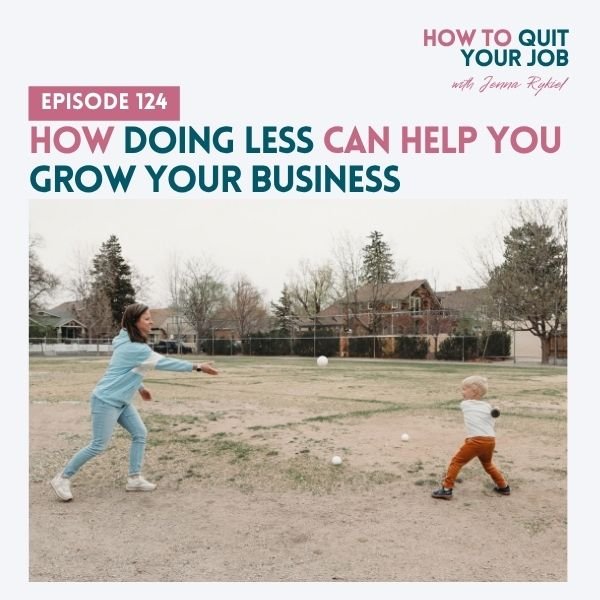
When you’re building a business alongside motherhood, it’s easy to believe that doing more is the answer. More strategies, more content, more learning, more clients, more time spent trying to make everything work. But sometimes, trying to do too much is actually making it harder to create the results you want.
In this episode, I share what I’ve learned about doing less in my own business, from stepping away from strategies that took more energy than they were worth to letting go of the pressure to create the perfect signature system. I also share how I’ve changed the way I approach webinars, following up with potential clients, and taking time away from my business, and why managing your energy can matter more than managing your tasks.
I’m not talking about stopping your efforts or hoping your business will magically grow. I’m talking about taking some of the pressure off, trusting yourself, and focusing on what actually moves you forward. You don’t have to make every action a home run. Sometimes, you just need to put the ball in play, keep showing up, and take the next step.
Ready for clarity and a simple action plan to get your business started? Schedule a free 1-hour consultation with me here!
What You’ll Learn from this Episode:
Why doing more isn’t always the best way to create results in your business.
How to manage your energy instead of focusing only on managing your tasks.
Why trying to use every strategy or follow every piece of business advice can create more pressure and mental drama.
How simplifying your approach can give you more energy to connect with clients and potential clients.
Why taking time away from your business can create space for creativity, rest, and new opportunities.
How to follow up with potential clients from a place of connection instead of desperation.
How to keep taking action without making every action responsible for creating a huge result.
Listen to the Full Episode:
Featured on the Show:
Click here for step-by-step instructions to leave a rating and review to let me know what you think, and don’t forget to share the podcast with others who you think would benefit!
If you're looking for the right environment to start your networking journey, look no further than my group, the Mom Entrepreneur’s Circle. Sign up here for mutual support, advice sharing, and the tools you need for both you and your business to thrive.
Forgetting Sarah Marshall - movie
Episodes Related to Doing Less to Grow Your Business:
116. It’s Always Working: How to Reduce Mental Drama and Build Your Business
123. The Enoughness Problem: How to Stop Building Your Life From Lack
Full Episode Transcript:
You're trying to learn all the things, you're trying to figure out how to find clients, you're trying to make sure you're doing everything right, and you're doing all of this while also trying to be the mom you want to be. But what if all of that effort, all of that pressure, all of that trying to make something happen is actually making it harder and leaving you with fewer results that you can celebrate? What if you could create more movement, more results, and more fun in your life and business by not trying to do so much.
That's what I want to talk about today and we're going to start with a little inside joke between my husband and me that has to do with baseball. So bear with me here, even if you're not a baseball fan, because I promise this is going somewhere and I promise you're going to learn a lot more than you ever wanted to about baseball by the time we're done here.
Welcome to How to Quit Your Job, the podcast for moms ready to ditch the nine-to-five and build a life and business they love. I’m your host, Jenna Rykiel. Let’s go.
Hi, mom friends. This is episode 124 of the How to Quit Your Job podcast. And I know that many of you might not be baseball fans. I don't know how many listeners are baseball fans or Orioles fans. I am originally from Baltimore, so I'm an Orioles fan for better or worse. This season it's been for the worse. But at the end of each baseball game, there's usually an interview with whoever was the standout player of the game. Maybe it's the person who hit a walk-off, which just means that they got a hit that won the game, or the person who pitched the best, or the person who made the biggest impact.
And when we watch these interviews, my husband and I, there's a theme that we've picked step on. My husband and I often joke about the interviews themselves because these players seem to be very well coached on how to do them. There are common phrases that are repeated. They all have the same tone and demeanor. And honestly, it's just funny to watch because these interviews are so predictable. No matter who the player is, they give credit to the team. They give credit to the coaches. They minimize their impact so that they seem humble. It’s really quite fascinating. I'm not sure if that's every team, but the Orioles definitely have a great PR coach.
One thing they constantly bring up when talking about hitting is that they aren't trying to do too much. They'll say something like, I wasn't trying to do too much out there, or I was just trying to put the barrel on the ball. The barrel being the thickest part of the baseball bat. This not trying to do too much phrase basically means they're not going up to home plate, trying to hit a homerun or a grand slam. They're just trying to put the ball in play. They're just trying to put the bat on the ball. They're trying to get a good pitch to hit. They say that too. They just want to make contact and put the ball in play.
And we laugh about this because it's one of those things that comes up constantly in every interview. But I was thinking about it the other day and I was coaching a client and this phrase just kept coming up. I started thinking about the impact of that phrase on business. I started thinking about how it could apply to this client who was definitely trying to do too much. And then I started thinking about how I've shifted my own business and shifted myself as a business owner over the last couple of years. Because As funny as that phrase is to my husband and me, I actually think it's incredibly important. I'm not trying to do too much.
There's another funny example that comes up for me in the movie, Forgetting Sarah Marshall, which is a classic. And I actually don't even know if I'm remembering it right. I didn't cross check, but the main character is learning to surf and the instructor just keeps telling him to do less. He just keeps saying, you need to do less. And it's a funny part of the movie because the main character, Jason Segel, which I actually did look up his name because I am terrible with actors’ and actresses' names, actually anybody who's famous.
But the main character, Jason Segel, doesn't really understand what this means. He doesn't understand how to do less. And I think that's how a lot of us feel in our businesses, especially as moms. We're so used to doing so much that the idea of doing less almost doesn't compute. Like, what do you mean do less? How am I supposed to do less when I have all these things that need to get done? It's so important for us to embody this do less energy, the energy of not doing too much, the energy of doing less. And I want to explain what I actually mean by all of this. And I have a few great examples to share as well.
But when I talk about doing less, I don't mean cutting a whole bunch of things out of our lives or cutting a whole bunch of things out of our business venture or what we want to try and create and learn. I know the reality for moms is that we can't just cut everything out. Sometimes we can't cut anything out. We have these little humans who need to be taken care of. We have families, we have responsibilities. We've got to show up and we've got to do those things. And for some of you, you're still working a full-time job on top of everything else. And you have to show up for that. So I'm not here to tell you to magically clear your calendar or pretend you don't have responsibilities.
But when it comes to our business, and when it comes to how we look at the energy and effort we put into our business, I often see that we're just trying to do too much. We're trying to get that big hit. We're trying to hit the home run. We're swinging in for the fences. And then we strike out because we take our eye off the ball. We are so tense and so obsessed with getting that big hit that we actually miss. And after we miss and strike out a dozen times, it's so easy for us to give up.
Another very interesting thing about baseball is how mental it is. Players have hitting streaks constantly and players have slumps constantly. And let me tell you, when you have a player that has gone 0 for 13 at the plate. That means 13 times they came up to the plate to hit the ball, and they did not hit the ball any of those 13 times. They are far less likely to get a hit than someone who is on a hitting streak. It's amazing too, because players will be hot, meaning they are getting a lot of hits, or even getting a lot of strikeouts if they're a pitcher, and then suddenly they stop performing, and sometimes they actually never get it back. I've seen that so often. And when they are in a slump, they are stuck.
There's a player on the Orioles who was amazing just a year ago. We signed a big contract with him. He seemed like the new face of the team. The entire season he carried the team with his bat and with his defense on the field. And this year he has struggled mightily. Constant striking out, not getting hits, even making errors in the field. And then when he's in the slump, it's been clear that he just started to try and do too much. He got tense and frustrated with his performance and it showed and it didn't make him perform any better.
When we're in this headspace, when we're striking out and not performing in our business, not signing clients, not making money, not doing the things we said we were gonna do, not checking items off our to-do list, it's easy for us to think that nothing is working. It's easy to start questioning whether this business is even going to work, whether we're cut out for entrepreneurship, whether we should just go back to what we know, go back to corporate, give up on entrepreneurship and stay in corporate.
If you haven't listened to it already, episode 116 is a great one to check out. It's about a mindset shift to see things as always working. But the pressure and tension and frustration is especially important if you're coming from a traditional career where you had a lot of direction. And I would say it's even more common to put that pressure and tension on yourself.
Because if you came from a traditional nine to five with a team, you knew what your job was. You knew what was expected of you. You probably had someone telling you what needed to get done. And when you step into building a business of your own, and you're the one who has to figure all of that out, of course you're going to feel pressured to do everything. Of course you're gonna want to find all the strategies that work because you don't wanna fail. But what if the answer isn't to put more pressure on yourself, or to learn, master, and execute more strategies for that matter? What if it's to take some of that pressure off yourself and off the business? What if it's to do less? What if you could go up there, have some fun, and just try to get a good pitch to hit? You're not trying to hit a home run every single time. You're just trying to put the ball in play.
And I know the baseball analogy might not landing for everyone because I've only met a few people in this community who like baseball. But here's the point. It's really important for us to manage our energy more than we're managing our tasks. Our worth is not measured by our productivity. My favorite line in the whole world, our worth is inherent. You don't suddenly become more worthy because you did a bunch of stuff and completed a bunch of tasks and signed a bunch of clients. You're worthy as you are. But also you're probably a better version of yourself in all aspects of life if you are more focused on managing your energy than worrying about adding more tasks to your plate.
In managing our energy, that's when we start doing less. That's when we start not trying to do too much. Let me give you an example of how this has played out in my own business. For many years in my business, I was trying to do it all. I knew there were a million ways to create clients and I wanted to try them all, right? I didn't wanna fail. I wanted to see what worked and what didn't work and I wanted to do more of what worked and I wanted to sign more clients and make sure that my business was okay. And it took a lot of time and energy to test lots of different things. It also took a lot of time and energy to learn different methods and strategies.
It was also frustrating because oftentimes I was learning without being able to ask anyone questions. We buy a course and we learn and we don't really have questions to ask people or we don't really have someone that we can ask. We don't have like mentors at every turn. I'm going to use webinars as an example because because this is one area that has really evolved for me over the years. But at the beginning of my business, webinars took an extreme amount of time and energy. I'm talking months to plan, months to execute, months to recover from the energy that was put out for one hour of training, one hour of teaching, one hour of connecting, one hour on the screen with my people.
And I'm going to be honest, looking back, not a lot was coming out of it. And I don't necessarily mean like signing clients. Even just like the impact and the results from the people who were attending, because there was so much energy being expended just to get these things going. And because they were so taxing, I did fewer of them. Of course, like I probably did one webinar a year, to be honest, because it was such a big deal for me. It was a huge event. I would be nervous. I'd be sweaty. I'd be anxious. I'd worry about how many people were gonna show up, I'd worry about whether it was working, I'd worry about whether I was giving enough value, and all of that worrying was exhausting.
But over time, through a lot of energy work and mindset work, things started to shift. And when I say energy work, I mean work around managing my energy, managing my thoughts around webinars, managing my thoughts about myself around webinars. I'm not talking about like manifestation or energy healing. I'm talking about something as simple as noticing when I'm anxious about whether I'm going to give enough value in a webinar. Noticing if I'm stressing about it, worrying about it. Noticing that it's an energy leak. Because I'm exhausting myself and just worrying about something that hasn't even happened yet.
But mind management and energy management mean that maybe that thought still comes in. That worry still comes in. Maybe I still have the moment where I'm wondering whether I'm gonna give enough value. But the energy management piece of it is then having a little bit of self-talk, a little bit of reassuring self-talk, self-trust, reminding myself that I'm gonna do my best to give as much value as possible. And it's just my job to put it out there, right? It's everyone else's job to soak it up and utilize it. It's sort of a bless and release. I'll do my part. That's what I mean by energy management.
And over time, through a lot of my own coaching and work with my individual coach, I got pretty good at managing my energy. Now, putting on a webinar might look like four hours of actual prep, an hour of being on screen, an hour of connecting with people afterwards through a Q&A, and maybe a half hour or an hour of decompressing. I always need some extra time because I'm an introvert. But that's the energy investment now. I could easily think of an idea and put together a webinar within two weeks, giving myself some time to tell people about it. But the difference between how I operate around webinars many years ago and how I operate now is that right now, I'm not trying to do too much. I'm not trying to hit the ball out of the park.
What I'm trying to do is connect with people. I'm trying to give value to people. I'm trying to give people an opportunity to show up for themselves. I'm trying to show them what support looks like. That's it. I'm not trying to do too much. And that actually allows me to do more webinars. I don't spend a ton of time stressing and trying to figure out how to get more people there. Because when I was doing one webinar a year, it was this big event that took so much of me, so much of my brain power. But by approaching this strategy in a way more relaxed, calm, more confident fashion, that also has a lot of self-trust built in it, I can actually do a lot more. I'm doing less because I have less mental drama. I'm doing less reinventing the wheel every time.
Nowadays, maybe I reuse a slide deck and reuse emails promoting it, knowing that there's constantly new people seeing the emails, there's constantly new people coming into my world. And the benefit of not trying to do too much in those webinars, again, is that I can actually create even more value. It's crazy, right, how this works. I'm spending less time and energy worrying about the webinar and I have more energy available to actually connect with people who show up. That's an incredible shift. And this shows up in tons of different areas of our business too.
Another super quick example of how this shows up, I just came into my mind earlier today was I spent so much time worrying about having a proper program for my clients. There were a lot of gurus out there saying that you need a course, like you need a blueprint that every client follows. You need this thing that you trademark, this thing that you can then talk about these steps, like these steps that are yours, these steps that are unique to you that people will know you by. I even worked with a coach many years ago who this was part of her program for the coaches she was coaching. You know, she was very big on you need this very regimented process that people follow. And that will lead to everything else in your business being easier.
And I spent a lot of time trying to figure this out. I spent a lot of time trying to figure out what is my signature system? What is the thing that makes me different? What is my trademark acronym, right? I even toyed with a couple of things and created like graphics around it. Nothing ever felt right though. Everything felt like it was too prescriptive. Everything felt like it was creating a situation where my clients weren't getting what they needed. They were just getting this signature system that I decided was a one-size-fits-all. And again, I spent a lot of my work time worrying about that, thinking about that, developing that, building graphics around that, trying to talk about that. so much time was spent developing that.
And then I realized that it just wasn't what was best for my clients. We get to a place with self-trust, where we're tapping into alignment, and then we realize that it's just not for us, right, the signature system. So now I have tools that I teach every single client, and those tools, we go through them, and we go through the entire coaching program. I still call it a program, but we evolve at the speed that the client needs and in the ways that the client needs. I don't have a prescription of what you need to do first. We feel it out. And it's so individualized, which is so much better for my clients.
My clients actually didn't want structure in the way that some people had it. They didn't want to watch a module and then need to go out and do that thing. Everybody was so unique in what they were coming to me with, with what their strengths were and what ideas they had that it just didn't make sense to have a signature system.
Another perfect example of trying to do too much, trying to do too much because all the gurus and people who are successful out there were telling me that I needed to do that when actually doing less, doing less in terms of not preparing as much prescriptive material actually helps me to do more. It allows me to give more value to my clients. It allows me to really see my clients, meet them exactly where they are, and get them moving forward where they are. It's not having them jump into something they're not ready for.
I also like to think about this when we're desperate to sign clients. I've talked about this before on the podcast, or when we're like desperate to get in touch with somebody that we haven't heard from, maybe about a proposal we sent out. When we get this desperate energy, we might send multiple emails, maybe some text messages. We call them, we're trying to figure out whether or not they're interested. And sometimes we're doing too much, not necessarily because the tasks themselves are wrong. It's not eliminating tasks or eliminating how we reach out, it's energy management. There's not a magic combination of text calls and emails, although a lot of salespeople will tell you that.
And I certainly used to abide by that earlier in my coaching business, especially coming from a sales background. But it's not so much about the tasks or the specific types of follow-up. It's about the energy that we follow up with. Are we following up from this desperate place of needing to get the big hit? Needing to hit the ball out of the park? Needing this person to say yes because we're putting so much pressure on ourselves and our business? Or are we following up from the energy of just trying to make a connection? Trying to put the barrel on the ball. Trying to put the ball in play. Not trying to do too much.
Maybe you're following up because you genuinely want to connect with that person. You want to see if they have questions. You want to see if the support you offer something they need right now, you can do that without making their response mean something about you or your business. You can do your part and allow them to do theirs. It's that bless and release energy again. You do your best, you show up for yourself and your potential clients or the people you serve and you trust that they will know when they are ready.
This doesn't mean that you don't follow up with people. It just means that you manage your mind and your emotions and remove what I call mental drama before following up. Follow up from a place of enoughness, like I talked about last week. And I really hope there are some listeners out there who love baseball because I just love talking like baseball players in these interviews. Like I said, my husband and I have so much fun doing it. I actually think this analogy is really perfect.
But even if you know nothing about baseball, I want you to think about the energy behind what you're doing in your business. Oftentimes, the task itself isn't the problem. It's not that you're doing the wrong thing or the wrong strategy, or the right thing or the right strategy, or that you need to try new things, even. So often, it's actually the energy we're doing those things with. It's the pressure and chaotic energy we often have when we're doing any of these things because we're trying to do too much.
Now I know this is really tough to do because we feel like we need to give it our all in order for this thing to work. We feel like if we're not putting every single piece of our strength, every single piece of our knowledge and every single ounce of energy into our business, we're not giving it a proper shake and we're going to fail. If we're not focused on our business and what will make it work 24 seven, we might tell ourselves that we're not trying hard enough, that maybe we don't care enough. Maybe we don't really want it badly enough. And I want to offer you a different way to think about it.
Your business, even if you're just starting, even if you don't have any paying clients, even if you don't know what your business idea is yet, is just going to be one piece of your life. One piece. It should never be your whole life, especially if you're listening to this podcast. Because if you're listening to this podcast, it probably means you have kids, you have a family. And for a lot of you, the whole reason you're even thinking about starting a business is because you want to create a different kind of life for yourself and your family. You want more flexibility, you want to be available for your kids, you want to have meaningful work and build something of your own without sacrificing the kind of mom you want to be.
So what happens when we start building a business and it feels like we need to figure every strategy out that's in the books and follow every guru and learn every business tip? We end up recreating the very thing we're trying to get away from. And that's not what I want for you. I want you to consider that your business doesn't need all of you. It just needs some of you. It needs some of your energy, some of your time, some of your attention, some of your creativity, some of that beautiful brain, and when we properly balance that with giving time to ourselves as human beings and giving time to our families as moms and the CEOs of those families, I believe our businesses will be much better off. I know it sounds counterintuitive, but what if instead of straining to figure everything out and make everything work, instead of giving it 110% every minute of every day, you approached it with a little more ease, a little more confidence, a little more trust.
What if that allowed you to create more, more results, more forward momentum, more movement, more fun. This became very, very clear to me as a possibility over the summer. I went on vacation and my coach said something to me that really stuck. She said, what if you actually create more in your business by truly taking two weeks off instead of trying to do any work. I had actually just taken a two-week trip the month before, and so it was feeling kind of tight. But she said, how could it actually be better for your clients if you took those two weeks off entirely?
This was actually a time in my business, so just recently, where a lot of my clients were wrapping up and finishing up the program. And I remember looking ahead on my calendar and seeing just two hours of coaching clients on my calendar after the summer. And my brain went into freak out mode. That was not enough. I was doing all the things that I said not to do last week. I needed more clients, it wasn't enough clients, I needed to do more, maybe host more events, do more to create more clients, right?
And my coach said, what if you just actually took that time off? What if you came back to a lot of consults, a lot of movement, a lot of potential clients? Wouldn't that be cool? That's what she said. And so we worked on that. How could it be true that me taking time off could actually benefit my business? How could I do less and it actually allow me to create more energy for my business when it mattered? And we came up with some examples. Some of the examples included taking the time off would allow creativity that can only come with truly checking out.
I came up with the opportunity to show my clients and potential clients that they can do that too. Right? I'm always preaching breaks. So I needed a role model that the benefit of taking a break emotionally and physically, all the benefits that I preach all the time about taking breaks for me to actually soak that in. We talked about taking the time off and the benefits of being in a beautiful place and soaking it in. And so I took that time off. And I kid you not, when I came back from that vacation, I had more consults on the books. I had more clients who wanted to continue. I had more people referring me to other people, putting me in touch with potential clients, sending me emails, what felt like out of the blue. So many people finding the podcast.
I had so much action happening in my business, more action than I'd had in my business when I was really pushing for things, when I was doing everything I could every minute. I had so much more action, and I was able to dedicate so much more energy, vibrant energy, rested energy, to those consults, to those emails, to those people who were reaching out and connecting me with friends.
Now, I'm not saying that if you take two weeks off, you're automatically going to come back to a bunch of new clients and results in your business. That's not the point. The point is that I had been operating as though I needed to constantly be doing something in order to create results in my business, constantly doing things in order for my business to work. And this experience helped me see that that wasn't necessarily true. My business didn't need me pushing every single minute. There were things I had already put in motion. Sure. There were relationships I had built. There were clients I had supported who wanted to continue getting support. There were clients I supported who had friends who were now inspired to get support. And those things didn't just disappear because I stepped away for two weeks.
And since that vacation, I've carried this on. My Thursdays and Fridays are lighter work days. Sometimes they are just personal days. And it's been really great to have extra time and space to fulfill other goals that I have that have nothing to do with my business. It's been great to have space to dedicate to coffee with people in my network or self-care activities. I've been leaning into that. I've been appreciating the time. I've been not worrying about all the things I'm not doing in my business. I've I've just been focused on helping my clients get results and not trying to do too much. And it's been really great.
In fact, I haven't done a webinar since June and my client load is full. That's not to say I'll never do a webinar again or that webinars don't work. I really do think they're a valuable strategy, but I'm not trying to do too much and that has created big wins.
So I wanna bring this back to you because I'm sure you're listening and thinking, okay, Jenna, that sounds great, but I have a business to build. I have clients to find. I have things I need to figure out, and I get it. I'm not suggesting that you stop taking action. I'm not suggesting that you stop learning or trying new things. And I'm certainly not suggesting that you just sit back and hope the business magically works. Hope is never a good strategy by itself.
What I am suggesting is that you pay attention to the energy you're bringing to the things you're doing, the things you're already doing? Are you trying to make every single action produce a huge result? Are you putting so much pressure on your next social media post, your next sales conversation, or your next offer that you're exhausting yourself before you ever get there? Are you trying to do all the things because you think that's what a successful business owner is supposed to do? And is all of that actually helping? Or is it making it harder for you to keep going?
Because I think one of the most important things can learn as business owners is how to keep going, how to keep showing up, how to keep taking the next step, even when the last one didn't work, how to step to the plate after striking out with confidence that we can make contact and put the barrel on the ball. When every action feels like it has to be a home run, it's really hard to keep going. It's actually exhausting. We take the pressure off. We give ourselves room to learn. We give ourselves room to experiment.
So maybe next time you're sitting down to work on your business, instead of asking yourself, like, what more can I do? Or what is the thing I'm missing that I need to figure out? I want you to ask yourself, how can I stop trying to do too much? How can I stop overcomplicating the steps? What would this look like if it were fun? What would this look like if it were simple? Maybe that means preparing for your next webinar without spending weeks worrying about whether it's going to be good enough. Maybe it means following up with a potential client from a place of connection instead of desperation. Maybe it means focusing on just one strategy long enough to actually see what happens instead of trying every strategy you've ever heard of.
Or maybe it means closing your laptop when you said you would and being fully present with your kids without spending the entire time thinking about all the things you're not doing in your business. I want you to think like, what would that look like? What would that feel like? I think it would change the game for you.
Okay. I want to leave you with this. The next time you feel yourself getting tense about your business, the next time you start worrying that you're not doing enough, the next time you feel like you need to give it 110% or else it's never going to work. I want you to remember those Orioles baseball players. They're not going up to the plate trying to to hit a homerun every single time. I mean, some of them are, but the ones who are getting interviewed at the end of the game, because they had the most positive impact, they all say that they're not trying to get a homerun. They're just trying to get a good pitch to hit. They're trying to put the barrel on the ball. They're just trying to put the ball in play.
And I want you to think about what putting the ball in play looks like in your business. What's one thing you can do that moves you forward without making this huge stressful event? What's one thing you can approach with little ease, little more confidence, a little more self-trust? Or maybe what's one thing that you can eliminate? What's a strategy that you can just put on the back burner for now because it just doesn't feel aligned? Okay, you don't have to hit a home run every time. You don't have to make every action the big event. You don't have to do it all. Just keep showing up, keep learning, taking the next step and maybe just stop trying to do too much. Okay? I'll see you next week, my newly converted baseball fans.
Thanks for listening to this week’s episode of How to Quit Your Job: A Mom’s Guide to Creating a Life and Business You Love. If you want to learn more about how I can help you stop making excuses and start making moves, head on over to www.jenna.coach. I’ll see you next week.
Enjoy the Show?
Don’t miss an episode, follow the podcast on Spotify, Apple Podcasts, or RSS.