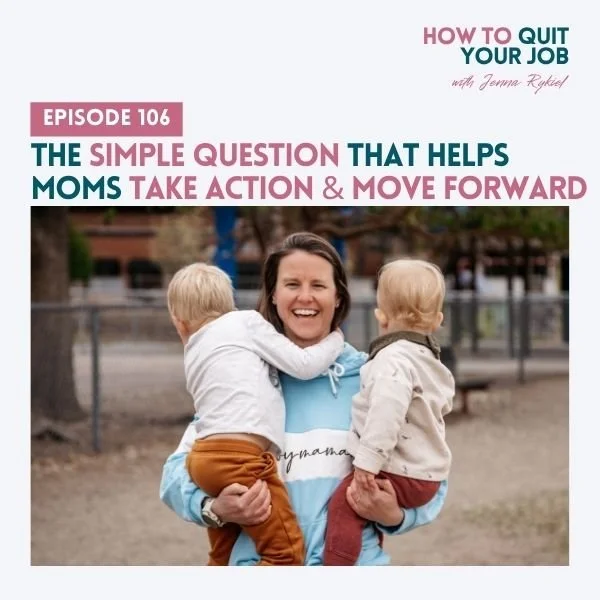
106. The Simple Question That Helps Moms Take Action & Move Forward
Do you ever feel like you're behind or overthinking every move in your business or your life? Like you're waiting for the perfect moment to act, or you should be further along than you are? So many moms experience this, and it can leave you stuck, second-guessing, and spinning in place instead of moving forward.
In this episode, I share the simple question that helps moms feel lighter, calmer, and able to actually take action and move forward. I explore why overthinking keeps us in a loop of hesitation and how asking this single, powerful question can shift your perspective and completely change the way you think about your business, your time, and your relationships.
If you've been feeling stuck, behind, or waiting for the "right moment," this conversation will help you see a new way forward. You'll hear examples from real-life moments in my coaching practice and learn how shifting your mindset can help you move past hesitation, embrace action, and start creating momentum today.
Ready for clarity and a simple action plan to get your business started? Schedule a free 1-hour consultation with me here!
What You’ll Learn from this Episode:
Why our brains naturally focus on problems and worst-case scenarios.
How to use one simple question to feel lighter, calmer, and more capable.
Why shifting your mindset can help you move past overthinking and self-doubt.
How small mental shifts can have a ripple effect across multiple areas of your life.
Real-life examples of moms using this question to make meaningful progress.
Listen to the Full Episode:
Featured on the Show:
Click here for step-by-step instructions to leave a rating and review to let me know what you think, and don’t forget to share the podcast with others who you think would benefit!
If you're looking for the right environment to start your networking journey, look no further than my group, the Mom Entrepreneur’s Circle. Sign up here for mutual support, advice sharing, and the tools you need for both you and your business to thrive.
Episodes Related to The Simple Question:
Full Episode Transcript:
And I want to share that simple question with you today as a tool, as a strategy, as something simple that you can keep in your back pocket so that you can feel lighter and calmer and able to actually move forward too.
Welcome to How to Quit Your Job, the podcast for moms ready to ditch the nine-to-five and build a life and business they love. I’m your host, Jenna Rykiel. Let’s go.
Hi, mom friends. So today, we're going to talk about why our brain naturally looks for problems and worst-case scenarios, especially when we want to make a change. And I want to talk you through one really simple question that has been helping my clients completely shift the way they think about themselves, their business ideas, their time, and honestly so many other elements of their lives.
There is a new tool or strategy, this question, that I've been leaning into with my clients. So much of the work that I do with them is really figuring out our thinking that is holding us back. A perfect example of this happened earlier this week. I had a newer client who talked to me about a business idea she had. And then immediately after talking through a pretty great idea, she said, "But then my brain thinks, should I even stay in this industry? Or is this just all I know?"
And from there, we explore the confusion, that feeling of confusion, we explore the questioning, we figure out why her brain immediately jumps to an existential crisis. This is a really big part of the coaching I do with people. It's a really important part. With this client specifically, we figure out that as long as she keeps questioning these big life questions and decisions that honestly can't really be answered, she has a really good reason not to take action. She stays stuck, and that feels good to the brain.
And we all have some flavor of this going on all the time. There's less risk in staying stuck and questioning and really feeling like we're being responsible with our questioning than actually taking action and starting a business. This is what our brain wants us to do. Our brain wants us to stay safe and wants to keep the status quo. It does not want us to fail. It does not want us to try anything new.
So when I'm exploring this with clients, and again, I'm talking about this piece because it's almost at odds with what I'm going to teach you today, but it has just been so powerful that I want to kind of give you a taste of both. But I have a tool that I teach all of my clients that's called the model, and that was created by Brooke Castillo from The Life Coach School. It's a fantastic tool for awareness and figuring out what exactly is keeping us stuck.
From that knowledge, we can then start the process of figuring out how to get unstuck, which is a beautiful thing. We need to know the pieces of our brain that are keeping us stuck, whether it's the confusion, self-doubt, feeling uncomfortable, incapable, any of those things they get uncovered with this tool that I teach my client.
The tool, again, is incredibly powerful for awareness and understanding why we feel stuck. But lately, there's been this one simple question I've been using with clients that has been creating really powerful shifts almost immediately. And it's a simple question that gets them out of the default space. So I refer to our thoughts that keep us stuck as sometimes our default thoughts. It's what our brain is just giving us. Like we kind of feel like we don't even have control over it.
So the simple question gets us out of that default space that our brain naturally goes into, the space that questions basically everything. It finds the worst-case scenario for everything and keeps all of us stuck. We're all experiencing it, so you're not alone if you are a worst-case scenario thinker, if you're a questioner, if you're an overthinker, all those things. But this question instead leads us to answers and a headspace that we can actually take action from. It's such a powerful reframe within one simple question.
But before we get into that, I really want to revisit and just briefly talk about why our brain defaults to the worst-case scenario because I know this happens for all of us. I've never met a mom who wanted to leave the life of a nine-to-five job and start a business who didn't have reservations. I've never met a mom who was not afraid of losing the steady paycheck. We worry about inconsistent income. We wonder if the idea will be good enough and if it will actually make money. We think about whether the market is too saturated. All of these things come up when I'm talking to a mom in the consultations that I do, the free 1-hour consultation to really see if coaching is the right fit.
All of these worst-case scenarios, all of these worries come up. They worry about whether they'll have even less time for their family, right? So many moms are wanting to leave corporate, leave a nine-to-five for more time. They feel like if they start a business, maybe they'll have less time for their kids. Another one of my favorites that comes up all the time is being worried about whether or not they'll end up hating the business or realizing that they want to do something different.
And I love that one because it's truly an unsolvable question until you get into it. It's such a good example of our brain creating mental drama to keep us stuck. That's the type of question we're never going to solve in our head. There's no amount of logicing that's going to get you to the correct answer. There is no correct answer because you'll never know what something feels like until you actually do it.
Granted, there are very important ways that we test things out all by taking action, all by putting ourself in the arena, and then we are able to evaluate and make decisions on whether we like something, whether something feels good. But until we actually start doing it, everything is just an assumption. So when moms get stuck on that question, I always tell them, you're trying to solve a problem that's not yet a problem. Okay, let's solve the problem of figuring out the business idea and finding the first paying clients before we start trying to solve that bigger problem.
But my point here is that our brain will gladly dish us a million reasons why something might not work, a million reasons why something's going to be challenging, a million reasons how something could go wrong, some really creative reasons on how something could go wrong. And I don't want us to beat ourselves up for that. That's our brain doing its job. Our brain wants us to stay safe in our current state, our status quo. Our brain thinks that is comfortable, even if we're miserable. It doesn't want us to try anything new. And that's just our beautiful brain. I don't want us to beat ourselves up.
I want us to become aware of it though. I want us to be able to say, "Oh, hey, there's that fear popping up again. Or there's that thought that I'm behind creating anxiety again," which I'll dig into a little bit later if you've ever felt like you were behind or running out of time. It's very common. Or, “Hey, there's my brain creating confusion." My brain likes to do that.
And instead of immediately just believing these default thoughts, I want us to look at those thoughts like a spectator. I want us to observe them. There's so much power in observing them and seeing them as just a sentence in our head instead of absolute truths about ourselves and the world.
I've been challenging my clients a lot this week because there's been sickness, there's been headaches with their clients, and there's been a theme of feeling behind. And when I tell them to give me all the evidence as to why they are behind, it's almost always self-imposed expectations. There's not even clear deadlines that they're missing. It's all a bunch of gray area where they are coming up with the absolute truth that they're behind. They just feel so behind. But then it's really hard for them to give me really clear evidence on that.
So when we notice those things popping into our head, when our brain kindly gives us those unhelpful thoughts, I want us to recognize them as thoughts. This is what our brain naturally does. When we think about doing something new, especially something risky or uncertain like starting a business, our brain immediately starts scanning for danger. And you might feel like that's responsible, like you're being cautious and thoughtful. And I'm not going to argue entirely with that. I am a very risk-averse person. So I do some scanning. I do some thoughtful intake and thinking.
But I'm going to say that it leaves out an entire other half of the story, one that my clients usually only explore when I intentionally ask them to, which leads me to the simple question that I want you to put in your back pocket anytime your brain offers you a thought that doesn't feel good, a thought that I'm behind, or maybe this won't work, or I'm never going to be able to do that, or I don't know enough. The question is, how is the opposite true? That's it. How is the opposite true?
Earlier this week, as I mentioned, I had a client who was really stressed because she felt behind. She felt behind on client work. She was beating herself up because there were deliverables she wanted to have done already. And she just kept talking about how behind she was. So I asked her this question. I said, how is the opposite true?
And it took her a little time, but she came up with some really powerful answers. She said things like, no customers are complaining that I'm behind. Any deadlines or expectations that aren't met are self-imposed and not real. She came to the conclusion that like, it's her own expectations that she's setting. Like no one else is really going to be mad at her or, like no one else is thinking that she's behind.
She came up with that she's completing jobs regularly. She's getting through a lot of work. Everything that she wanted to get done in the spring was complete. There are no actual deadlines that she's missing. These are all things that she came up with. And I could tell that as she was coming up with valid reasons that the opposite was true, that she wasn't behind, she felt a sense of relief. She almost had this like exhale, this like full body exhale. She started opening herself up to the idea that maybe she wasn't actually behind.
Now, let me give you another example. I want to encourage you to do this with anything new that you want to start. And honestly, you can get pretty granular with all the different instances where you can ask yourself this question. If you want to start a business and you haven't yet, I imagine there's some different flavors of what your brain might be thinking. Your brain might be thinking, I don't know enough. I don't know what to do. I don't have any good ideas. I don't know what to do first. I don't know if this will work. Maybe this won't work. These are really common thoughts, and they're perfect for this question. This simple question of how is the opposite true?
So let's take the thought, I don't know enough. How is the opposite true? I really want you to answer that for yourself right now if this happens to be a question that pops up for you with anything you're grappling with where you think that maybe you don't know enough to do something. Maybe you're thinking about starting a consulting business in the industry you've worked in for years, and you're thinking you don't know enough. How is the opposite true? How is it true that you actually do know enough?
And I want you to answer it honestly. It might feel awkward because it feels a bit like bragging or none of us like to really talk about ourselves, but it does take a little bit of boasting and thinking about all the things that we are good at or all the things that we do know, right?
Another common thought is, I don't know what to do. I want you to ask yourself, how is the opposite true? It's so interesting when I ask this question because often moms have either already taken action and are discounting it. So they say they don't know what to do, but they've already done things, but they're not counting it.
Or they actually do have ideas on what they can do next, but they aren't allowing themselves to explore them. So how is the opposite true? How do I actually know what to do next? When you answer this question and start seeing all the ways that you might actually know what to do, at least one or two next steps, it creates such a beautiful shift in energy.
I believe and trust 100% that you know more of what to do than you give yourself credit for. What's really important about this exercise, this question, is that we are intentionally finding evidence for beliefs that create feelings that feel good and that serve us. Okay? When we search for and find evidence that we know enough or that we do know what to do, and by the way, these are legitimate answers. They aren't lies or made up, right? Like when we're answering these questions, they're they're valid answers. We're not going to reach for things that aren't true.
So when we search for and find true evidence that we do know enough, that we do know what to do next, we feel different. We're just finding evidence that already exists that our brain is ignoring because our brain wants to keep us safe. Our brain wants us to stay stuck. That's okay. That's our beautiful brain at work. And when we focus or when we start focusing on that evidence, on the evidence that our brain is ignoring, on the evidence that already exists, that the opposite is true of the belief that is holding us back, we feel different. Okay?
We feel more confident when we think about all the things we know. It might still be limited, but when we're thinking about the things we know versus the things we don't know, we're going to feel better. We feel motivated when we think about how we do know what to do. And those feelings shift actually what we do, how we take action, how we show up. When we feel motivated or energized or confident, we're more likely to take action.
Now, this simple question also applies outside of business. So I don't want you to limit its power to just starting a business or just creating clients or making this thing work. We can apply it to relationships. If you are a co-parenting mom with a partner, you've probably had thoughts about your partner, maybe not the kindest thoughts around help. And this is just from my own lived experience and from the experience I hear about in my one-on-one sessions on a weekly basis with my mamas.
We don't always have the most helpful, kindest thoughts about our partners. So maybe if you've ever thought something like they never help or, and excuse my language here, but or the thought, when I leave, everything goes to shit. Okay. Even if we don't want to in the moment, we can ask ourselves eventually, when we've cooled off, how is the opposite true? How is it true that my partner actually does help? How is it true that everything doesn't completely fall apart when I leave?
Yes, maybe the kids ate mac and cheese three nights straight, which doesn't feel amazing. Maybe the house is a wreck. But how is it true that everything is actually okay? The kids are alive, hopefully. The house didn't burn down, hopefully. And even if something broke or a kid got hurt, we still want to find evidence that everything didn't completely go to shit.
And when we again are finding those examples, that evidence that the opposite is true, 100% our relationships improve, 100% we communicate better. Maybe there are things that we need to talk to our partner about, things that were definitely not done optimally that we would very much prefer be done a different way if we're not home. Or maybe it is that we need help. We want help with something.
And so when we find all the evidence that our partner actually is trying, that our partner actually is helpful, all the things that they're doing, maybe it's taking the trash out, maybe it's doing the dishes sometimes or breaking down the recycling or driving the kids somewhere or taking the kids to the park or being more patient, right? Whatever it is, we find those examples, and we are more ready and willing and able to then take action in a way that's more productive. Action in communicating, action in saying how we need help or what we need, action in creating systems.
Here's another example that I think is so important for so many of us, and it's around time. So many of us default to, I don't have time. When we think about doing something new or adding something extra into our life, our brain immediately goes there. But if we stop and ask ourselves that simple question, how is the opposite true? And genuinely look for evidence, you know, part of this is we have to be open to the opposite being true. I guarantee you that the opposite is true in some way, shape, or form. You can find evidence if you're creative and if you open your mind. But when we genuinely look for evidence that the opposite is true, that we do have time, it completely shifts things.
I actually had this happen in my own life recently. A friend reached out with a potential business idea. And my immediate reaction was, no, I don't have time. Before I responded, I started looking at my week. I started doing some math. I started figuring out how the opposite might actually be true. And almost immediately, I started then feeling excited about the opportunity instead of immediately shutting it down. I find this especially interesting because with all of my clients, we go pretty deep into how they spend their time. That's a big part of coaching because how we spend our time is how we live our life. It matters. It's the most important thing, how we spend our time.
So I teach a tool that helps them become really intentional about and deliberate about spending time in ways that actually feel aligned with the life they want, even if they're at a job that isn't aligned. There are so many more hours in the day, and we can really make a lot of progress and create a lot of meaning and fulfillment in how we're spending the time outside of work, right? So all of that is important.
All of that comes into play in coaching. And when we start getting really granular about their calendars and their days, more often than not, we're able to find pretty big chunks of time than they originally thought existed. Not always huge chunks of time, but always some time. And like I said, often it is pretty big chunks of time once we are looking at it together.
One more non-business-related example that I think will really help in all of all of life is the thought that might come up every now and then about something being a waste of time. All right, like when we have this default thought, that was a waste of time. I want to use this one because honestly, I don't think, and I wasn't born with this thought, but through a lot of coaching, through a lot of self-reflection, through a lot of life work, I honestly don't think anything in our life is a waste of time when we are intentional about how we think about it.
If you want more on this specific topic, this comes up a lot in episode 49, How to Make the Most of a Business Investment because it is a way to prevent against a waste of time and money in business investments. So definitely check out episode 49 if you find that thinking something as a waste of time is a thought that comes up a lot for you.
But really, with anything we spend time doing, we can absolutely find evidence that it was worthwhile in some way. Let's say you went to a networking event and you leave thinking, oh my gosh, that was such a waste of time. And by the way, that thought doesn't feel good, which is the whole point here, right? When we think something was a waste of time, we feel so annoyed and frustrated. Maybe we feel guilty or we're beating ourselves up.
And I know because I've absolutely been there. With this specific example, I think I've talked about it before, but I left a networking event in a complete mental tizzy because my brain immediately started telling me all the things I should have been doing instead. It kept telling me how much of a waste of time that was. It kept telling me how bad the speaker was who was leading the event. It was replaying all the conversations that felt pointless. It was replaying all of the lack of conversations. I had to leave the event like right after the actual speaker ended, and I didn't get to meet anyone. It felt completely pointless.
But if we stop or if I stop and ask myself, how is the opposite true? How is it true that event was not a waste of time? We can find really helpful answers. So for that example specifically for me, it was really nice to get out of the house. The event was in the morning. I skipped out on morning duties. It was at a cafe, so I had a good cup of coffee and a breakfast burrito, which was a delight.
And even though I didn't meet anyone meaningful at that event, I went back the next month because I did a lot of mindset work on the thought that that was a waste of time and look at how it ended. I went back to the event the next month. And I go back every month.
I went back the next month, and because my face was familiar, it actually became easier to connect with people. People saw me there the week before. Even though I didn't connect with them personally, it made it more comfortable the next time I went. So that was evidence that it wasn't a waste of time. We can always find evidence if we're open to looking for it. And I promise you that finding evidence that something was not a waste of time or that you are good enough or that you do know enough or that you do have time or that you actually know what to do next, that evidence will always feel better.
And feeling better leads to actions that move you forward. Also, feeling better just feels better. It's one of the biggest goals of coaching and life, right? We just we kind of want to feel better on a day-to-day basis. It's kind of crummy to feel crummy. When you believe in yourself, when you feel confident and energized, you will absolutely also then move differently. You take action, you see opportunities differently, you create momentum and results.
At the end of the day, this work, it's about feeling better. It's not about pretending hard things don't exist or forcing ourselves to be positive all the time. Check out episode 105 about life being hard. I go into detail about that in last week's episode, and it's one of my favorites. But this isn't pretending that hard things don't exist or there isn't evidence for some of the more troubling thoughts. It is though about recognizing that our brain is already incredibly skilled at finding the evidence for fear and doubt and limitation.
And if we want to create something new in our life, if we want to create change, if we want to start a business, we have to become equally skilled at finding evidence for possibility, for capability, for support, for momentum, for growth. We have to be intentional. We have to work for it because it will not automatically pop into our brains. That's not how our brains were wired, and that's okay. We can work with it. Because the thoughts we focus on, like I've said, shape the feelings we create, and those feelings shape whether or not we actually move and take action.
Okay. If you're catching this live, there's still time to take advantage of the special opportunities I have happening in May. I know there's a whole bunch of you who get the download, who follow the podcast. It tells you that you get a little ping that this new episode is out. You listen to it immediately on your commute to work or whatever you're doing, and I love you for that. And if you're one of those people, there's still time to take advantage of the special opportunities that I have happening this month, the month of May.
The first, I'm hosting a free webinar on May 29th, so we're a couple days away from that. And I'm also giving moms the opportunity to try coaching in a way that feels safe and supportive. So if you have been coaching curious, this is a chance to experience the tools that I use with clients. I've mentioned the two main tools in this episode. One that really in a very life-changing way helps us to understand the default thoughts that our brain is giving us that may not be quite motivating.
Also, the time management tool that really helps us to create more time, to spend our time in the ways that feel aligned and intentional. So the experience that I'm offering in May teaches those tools. You're able to see if they work for you, really feel them, see what the community feels like within my container, and really get an idea of what one-to-one coaching support actually looks and feels like.
So these are opportunities to get into motion instead of staying stuck in your head. There will be links to all of these opportunities in the show notes. You can go to jenna.coach/106. You can also go to my website, jenna.coach, and there's ample buttons for you to set up a free consultation to learn about some of these opportunities. There's tons of ways that I am providing support, helping you move forward. This podcast is one of the ways, but there's so much more that we can do to get you into motion and stay in motion.
And so, definitely follow the podcast. Definitely keep this starred. Put it in your calendar. Listen to an episode a week. If you're just finding me, listen to an episode a day. There's enough to fulfill a few months there.
The goal here is I want you to stay in motion. A mom in motion stays in motion and a stagnant mom is miserable. So if you're feeling different flavors of misery right now, I get it. We've all been swimming in different puddles of misery every now and then. But stagnation may really be one of the biggest factors. And all of the things that I talked about today are ways to get you into motion, even just the simple tool, the simple question, try it, use it. It will get you into motion.
I want to get you into motion toward the thing you want to start, the thing you want to build, the thing you want to change. So like I said, be sure to follow the podcast so you never miss any of these opportunities. New episodes are released every week. And if you're feeling stuck, I want this podcast to feel like a little weekly nudge forward, a little lift, a little push, a little hand that's reaching out to pull you up, a little ping every Wednesday with strategies and tools and mindset shifts that help you move forward.
Okay, that's it for this week. I'm excited for you to start bringing just this simple question into your world and see how it changes things. I will see you next week.
Thanks for listening to this week’s episode of How to Quit Your Job: A Mom’s Guide to Creating a Life and Business You Love. If you want to learn more about how I can help you stop making excuses and start making moves, head on over to www.jenna.coach. I’ll see you next week.
Enjoy the Show?
Don’t miss an episode, follow the podcast on Spotify, Apple Podcasts, or RSS.